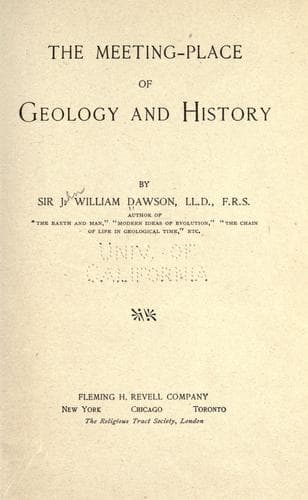
The Meeting-Place of Geology and HistoryDawson, John William, Sir
Religion
The Meeting-Place of Geology and History
Dawson, John William, Sir
Deluge; Prehistoric peoples
That the occupancy of these caves is very ancient is proved by the fact
that the old Egyptian conquerors, who cut a road for themselves over
these precipices before the Exodus, seem to have found them in the same
state as at present, while farther south ancient Syrian tombs are
excavated in similar bone breccias. But there is better evidence than
this. The bones and teeth in these caves belong not to the animals which
have inhabited the Lebanon in historic times, but to creatures like the
hairy rhinoceros and the bison, now extinct, which could not have lived
in this region since the comparatively modern period in which the
Mediterranean resumed its dominion over that great plain between
Phœnicia and Cyprus. This we know had been submerged long before the
first migrations of the Hamites into Phœnicia, even before the entrance
of those comparatively rude tribes which seem to have inhabited the
country before the Phœnician colonisation.[86] Unfortunately no burials
of these early men have yet been found, and perhaps the Lebanon caves
were only their summer sojourns on hunting expeditions. They were,
however, probably of the same stock with the races (the Cro-magnon and
Canstadt) of the so-called mammoth age in Western Europe, who have left
similar remains. Thus we can carry man in the Lebanon back to that
absolutely prehistoric age which preceded the Noachian Deluge and the
dispersion of the Noachidæ.[87]
[86] Some of these tribes also lived in caves, as that of Ant Elias, but
the animals they consumed are those now living in the Lebanon.
[87] Dawson, _Trans. Vict. Institute_, May 1884; also _Modern Science in
Bible Lands_.
If in imagination we suppose ourselves to visit the caves of the
Nahr-el-Kelb pass, when they were inhabited by these early men, we
should find them to be tall muscular people, clothed in skins, armed
with flint-tipped javelins and flint hatchets, and cooking the animals
caught in the chase in the mouths of their caves. They were probably
examples of the ruder and less civilised members of that powerful and
energetic antediluvian population which had apparently perfected so many
arts, and the remains of whose more advanced communities are now buried
in the silt of the sea bottom. If we looked out westward on what is now
the Mediterranean, we should see a wide wooded or grassy plain as far as
eye could reach, and perhaps might discern vast herds of elephant,
rhinoceros, and bison wandering over these plains in their annual
migrations. Possibly on the far margin of the land we might see the
smoke of antediluvian towns long ago deeply submerged in the sea.
The great diluvial catastrophe which closed this period, and finally
introduced the present geographical conditions, we have seen good reason
to identify with the historical Deluge, and the old peoples of the age
of the mammoth and rhinoceros were antediluvians, and must have perished
from the earth before the earliest migration of the Beni Noah.
Public-domain text, read in full here on John Shaqi.
Reviews
Reviews
No reviews yet
Be the first to share your thoughts on this work.
Elsewhere in the archive
Join the Discussion
Join the discussion
Sign in to leave a comment or review.
Sign InorCreate an account