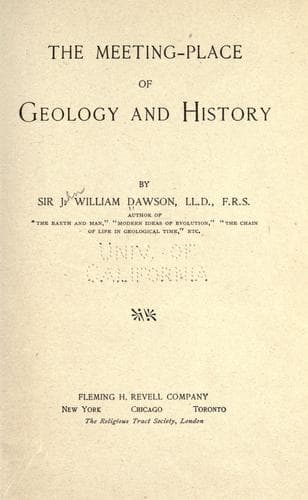
The Meeting-Place of Geology and HistoryDawson, John William, Sir
Religion
The Meeting-Place of Geology and History
Dawson, John William, Sir
Deluge; Prehistoric peoples
Were these changes sudden or gradual? Experience has no answer, for no
similar events have occurred in historic times, and though there are
records in the geological history of many mutations in the elevation of
the land, we have no information as to their rate of progress, and we
know little of their causes. The changes of this kind known to us in
modern times are merely local, not general, and in regard to their rate
are of two kinds. Some are abrupt and accompanied with earthquake
shocks. These are very local, and usually occur in regions of volcanic
activity. Others are so slow and gradual as to be scarcely perceptible,
and are often of wider distribution. It is evident, however, that these
slight and local phenomena furnish but little clue to the mutations of
past periods. These were on a far grander scale and affected vast areas.
We have no modern instances of these almost world-wide depressions of
continents under the sea, though we know that these have occurred, one
of them within the human period, and it is idle to speculate as to their
rate or duration in the absence of facts. We know pretty certainly,
however, from the gauges of time which can be applied to the close of
the glacial period, that this latest subsidence must have occurred
within six thousand years of our time.
With reference to the particular movement in question, we know that the
close of the palanthropic period was accompanied by a movement at least
equal to the difference between the wide lands of the second continental
period and the shrunken dimensions of the present lands. Besides this we
find on the surface of the land modern raised beaches, deposits of loess
and plateau gravels, intrusions of mud into caves of considerable
elevation, and evidences, as in Siberia, of large herds of animals
perishing on elevated lands on which they seem to have taken refuge.[26]
In short, no geological fact can be better established than the
post-glacial subsidence.
[26] Prestwich, 'Evidence of Submergence of Western Europe,' _Trans.
Royal Society_, 1893; 'Possible Cause for the Origin of the Tradition of
the Flood,' _Trans. Vict. Inst._, 1894; Dawkins, _Journal Anthrop.
Inst._, February 1894. Kingsmill and Skertchly (_Nature_, November 10,
1892) report the Asiatic loess to be marine, and to extend far upward on
the Caspian plain and the Pamirs, so that all Asia must have been
submerged within a very recent period. See also _Fossil Man_, by the
author, 1880.
Public-domain text, read in full here on John Shaqi.
Reviews
Reviews
No reviews yet
Be the first to share your thoughts on this work.
Join the Discussion
Join the discussion
Sign in to leave a comment or review.
Sign InorCreate an account