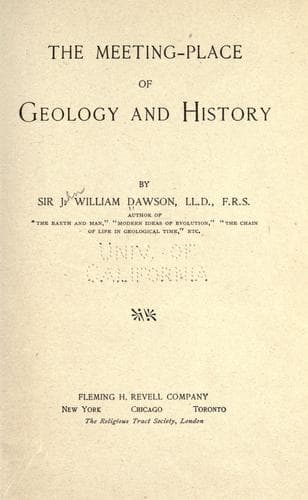
The Meeting-Place of Geology and HistoryDawson, John William, Sir
Religion
The Meeting-Place of Geology and History
Dawson, John William, Sir
Deluge; Prehistoric peoples
Putting these facts together, we cannot doubt that the submergence at
the close of the palanthropic age was very considerable, and that it was
followed by a partial re-emergence. Further, there is no evidence of any
serious fractures or folding of the crust taking place at the time,
though it is possible that great lava ejections like some of those of
Western America may belong to this period. It is therefore allowable to
suppose that the cause of submergence may have been either depression of
the land, or elevation of the bed of the ocean throwing its waters over
the land, or possibly a combination of both. Movements of these kinds
have recurred again and again in geological time. Their causes are
mysterious, but their effects have been of the most stupendous
character. Fortunately, they occur at rare intervals, and that to which
we are now referring is the last of which we have any record, and
differs from all others in having occurred at a time when man was widely
spread over the world.
The geological chronometers already referred to inform us that the land
of the northern hemisphere rose from the great pleistocene submergence
about eight thousand to ten thousand years ago, and the second
continental period with its forests and its teeming and widely-extended
animal and human life, may have been established within two thousand
years of that time, or say six thousand to eight thousand years ago. How
long the second continental or palanthropic period continued intact we
do not know, but we can scarcely allow it less than two thousand years.
Perhaps it was considerably longer. Now on historical evidence produced
by Egypt, Chaldea, and other ancient countries in the Mediterranean
region, we can trace the neanthropic age continuously back to, say,
three thousand years B.C., or nearly five thousand years in all. Adding
to this two thousand years for the palanthropic age, we are carried back
to a time within one thousand years of the earliest we can assign on
geological grounds to the termination of the great glacial period.
Therefore, unless we suppose the last continental subsidence to have
begun some time before the close of the palanthropic age, and to have
continued to some degree into the beginning of the neanthropic, we
cannot assign to it a very long time. That it could not have been sudden
in the sense of being instantaneous is evident, because in that case
terrestrial denudation of a stupendous character must have ensued, and
no animal life except that of mountain tops and elevated table-lands
could have escaped its destructive effects, but that it was by no means
secular or long-continued is certain.
Public-domain text, read in full here on John Shaqi.
Reviews
Reviews
No reviews yet
Be the first to share your thoughts on this work.
Join the Discussion
Join the discussion
Sign in to leave a comment or review.
Sign InorCreate an account