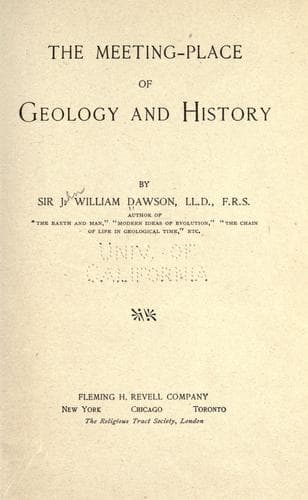
The Meeting-Place of Geology and HistoryDawson, John William, Sir
Religion
The Meeting-Place of Geology and History
Dawson, John William, Sir
Deluge; Prehistoric peoples
At Grenelle, near Paris, on the river Seine, there is a succession of
old inundation beds of that river, extending from the oldest part of
the anthropic to modern times, and furnishing what may be regarded as a
chronological series for Northern France, as many human remains have
been from time to time deposited on this old eddy of the Seine and
buried under newer accumulations. Belgrand has shown that in the lowest
gravels of this deposit the long-headed Canstadt man is alone found.
Immediately above this occur remains of the Cro-magnon type, and these
are associated with and overlain by beds holding large stones or erratic
blocks, a monument perhaps of the physical disturbances closing the
palanthropic age. Above these the next remains are those of a race of
men of smaller stature and with less elongated heads, which we shall
find belong to the neanthropic age. Here, as Quatrefages points out, we
have a distinct stratigraphical succession, which accords with that in
other localities.
If we now turn to England we may select from other examples the
Cresswell caves, so carefully explored by Dawkins and Mello, and in
which we have well-ascertained evidence from fossils as well as from
superposition. Without going into the details as to the several chambers
and passages in these caverns, we find as the result of the whole the
following succession in ascending order:
1. White calcareous sand, a deposit from water, but with no animal
remains.
2. Stiff red clay with blocks of limestone, and in places underlaid by a
ferruginous sand. These beds, of which the red clay is the principal,
contain bones of rhinoceros leptorhinus, hippopotamus, bison, bear,
hyena and fox, but no human remains. Dawkins, however, shows that in
other caves farther south some rude flint implements show that man had
already appeared in England, though he may not have made his way as far
north as Yorkshire.
3. Above this lies a stratum of red sandy cave earth, in which occur the
bones of the mammoth and the woolly rhinoceros, the horse, the bison,
the bear, and the hyena, but the leptorhine rhinoceros is gone. The
bones are gnawed by hyenas, and there are rude quartzite implements.
Over this, and representing the later part of the palanthropic age,
corresponding to some of the French, Belgian, and Lebanon caves, are an
upper cave earth and breccia, rich in 'palæolithic' flint implements and
bones of the animals of the mammoth age.
Public-domain text, read in full here on John Shaqi.
The Meeting-Place of Geology and History — John Shaqi
Reviews
Reviews
No reviews yet
Be the first to share your thoughts on this work.
Elsewhere in the archive
Join the Discussion
Join the discussion
Sign in to leave a comment or review.
Sign InorCreate an account