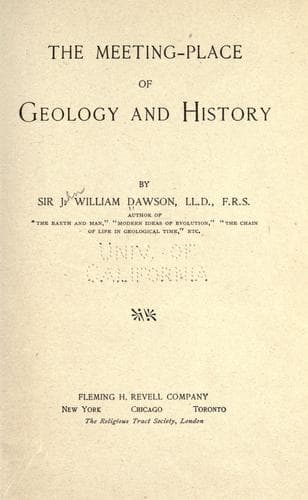
The Meeting-Place of Geology and HistoryDawson, John William, Sir
Religion
The Meeting-Place of Geology and History
Dawson, John William, Sir
Deluge; Prehistoric peoples
But if man was a witness of and sufferer in this great catastrophe, and
if any men survived it, did they preserve no tradition or memory of such
a stupendous event? We may imagine this to be possible. The survivors
may have belonged to the rudest and most isolated of the races of men,
and may have had no means of knowing the extent of the disaster or of
preserving its memory. On the other hand, they may have attained to a
sufficient degree of culture to have had some means of perpetuating the
memory of great events. If so, we may imagine that the great diluvial
cataclysm which separates the human or anthropic period into two parts
may have left an indelible mark in the history or tradition of mankind.
We shall inquire into this in the sequel, but must first consider what
geological monuments remain of the early neanthropic age in Europe.[27]
[27] A valuable paper by Dawkins 'On the relation of the Palæolithic to
the Neolithic Period,' reaches me when correcting the proof of this
volume. (Reprint from _Journal of Anthropological Society_, February
1894.)
In the meantime I may remark that, if we take the Canstadt people to
represent the ruder tribes of the antediluvian Cainites, the feebler
folk of Truchère to represent the Sethites, and the giant race of
Cro-magnon and Mentone as the equivalent of the 'mighty men' or Nephelim
of Genesis who arose from the mixture of the two original stocks, we
shall have a somewhat exact parallel between the men of the caves and
gravels and those we have so long been familiar with in the Book of
Genesis.
CHAPTER VII
THE EARLY NEANTHROPIC AGE
There has been much confusion among anthropologists respecting the
distinction of this from the preceding age. The Cro-magnon race has been
classed as neanthropic, and has been confounded with a very dissimilar
people which succeeded it after an interval of some duration. The gap
between the disappearance of the earlier race and the arrival of the
newer has thus been overlooked, and no account has been taken of the
great intervening faunal and geographical changes. This has arisen from
neglecting or being unable to appreciate the geological part of the
evidence; and the somewhat lamentable result has been that it is
difficult for the ordinary reader to arrive at any certainty, in the
midst of conflicting statements all based on imperfect data. In these
circumstances it will be well to begin this chapter with some examples
of the relations of these different races.
Public-domain text, read in full here on John Shaqi.
Reviews
Reviews
No reviews yet
Be the first to share your thoughts on this work.
Elsewhere in the archive
Join the Discussion
Join the discussion
Sign in to leave a comment or review.
Sign InorCreate an account