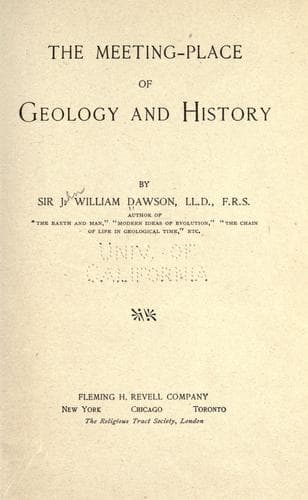
The Meeting-Place of Geology and HistoryDawson, John William, Sir
Religion
The Meeting-Place of Geology and History
Dawson, John William, Sir
Deluge; Prehistoric peoples
And there was not a man to till (irrigate) the ground.
And there went up a vapour from the earth, and watered the surface
of the ground.
This is the Hebrew idea of the condition of the great Mesopotamian plain
after the pleistocene submergence, and before the appearance of man. The
Chaldean version refers to the same region, but is more elaborate and
artificial, and brings in the historic cities of a later time. This
difference alone would induce us to suppose that the Hebrew record may
be a better guide for our present comparison.
The Hebrew writer in the first place gives us to understand that a
period of comparative desolation preceded the appearance of man, a great
winter of destruction preparatory to a returning spring. He then
proceeds to localise primeval man by placing him in Eden, the Idinu of
the Chaldean accounts, which we also recognise by the geographical
indications of the Euphrates and Tigris as its rivers, with two
companion streams which can scarcely be other than the Karun and the
Kerkhat. Thus the Bible and the Chaldean account agree in their locality
for the advent of man, for Idinu was the ancient name of the plain of
Babylonia. It has been objected to this locality that much of this
region is low and swampy, and has only recently become land by the
encroachment of the rivers on the head of the Persian Gulf. But if our
Biblical authority really refers to palanthropic man, we must bear in
mind that in the post-glacial period the continents were higher than
now, and the Babylonian plain must have been a dry and elevated
district, in all probability forest-clad. We must also bear in mind that
Eden was a region of country, and that the 'garden' or selected spot
'eastward in Eden' may have been some rich wooded island surrounded by
the river streams, and producing all fruits pleasant to the taste and
good for food. In any case the modern objections to the site are based
on entire ignorance of its geological history, and only serve to show
how much better informed the ancient writer was as to antediluvian
geography than his modern critics.[34]
[34] See, for full discussion of this, _Modern Science in Bible Lands_,
by the author.
It is scarcely necessary to say that this Biblical environment of
primitive man corresponds with the requirements of the case. In a genial
climate and sheltered position, and supplied with abundance of food, the
first men would have the conditions necessary for comfortable existence
and for multiplying in numbers.
Public-domain text, read in full here on John Shaqi.
Reviews
Reviews
No reviews yet
Be the first to share your thoughts on this work.
Elsewhere in the archive
Join the Discussion
Join the discussion
Sign in to leave a comment or review.
Sign InorCreate an account