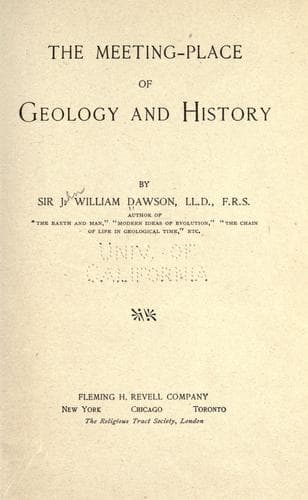
The Meeting-Place of Geology and HistoryDawson, John William, Sir
Religion
The Meeting-Place of Geology and History
Dawson, John William, Sir
Deluge; Prehistoric peoples
This at once testifies to antediluvian culture,
and shows that the means existed to record important events.
There is, perhaps, no one of the vagaries now current under the much
abused name of evolution more opposed to facts, whether physical or
historical than the notion that, because 3000 years B.C. we have
evidence of an advanced civilisation in Chaldea and in Egypt, this must
have been preceded by a long and uninterrupted progress through many
thousands of years from a savage state. Two facts alone are sufficient
to show the folly of such a supposition. First, the intervention of that
great physical catastrophe which separates the palanthropic and
neanthropic periods; and secondly, the testimony of history in favour of
the arts of civilisation originating with great inventors, and not by
any slow and gradual process of evolution. According to all history,
sacred and profane, many such inventors existed even in the palanthropic
and early neanthropic ages, and transmitted their arts in an advanced
state to later times. The Book of Genesis testifies to this in its
notices of Tubal Cain and Jubal; and the monuments of Chaldea and Egypt
show that metallurgy, sculpture, and architecture were as far advanced
at the very dawn of history as in any later period. It is true that
Genesis represents its early inventors as mere men, albeit 'sons of
God,' while they often appear as gods or demi-gods in the early history
of the heathen nations; but the fact remains that then, as now, the rare
appearance of God-given inventive genius is the sole cause of the
greater advances in art and civilisation. Spontaneous development may
produce socialistic trades' unions or Chinese stagnation, but great
gifts, whether of prophecy, of song, of scientific insight, or of
inventive power, are the inspiration of the Almighty.
We have in the closing part of the Bible story of the antediluvian age
even an intimation of the deterioration of climate and means of
subsistence towards the end of the period. Lamech, we are told, named
his son Noah--rest or comfort--in the hope that by his means he should
be comforted, because of the ground which the Lord had cursed. That
curse provoked by the sons of man he may have recognised as fulfilled in
the gradual deterioration of the climate toward the close of the
palanthropic age. There are here surely some curious coincidences which
might be followed farther, did space permit.
We now come to the close of the whole in the Deluge; and as this has
been made in our own time the subject of much discussion, and as it
contains within itself the whole kernel of the subject, it merits a
separate treatment.
CHAPTER IX
THE DELUGE OF NOAH
Public-domain text, read in full here on John Shaqi.
Reviews
Reviews
No reviews yet
Be the first to share your thoughts on this work.
Elsewhere in the archive
Join the Discussion
Join the discussion
Sign in to leave a comment or review.
Sign InorCreate an account