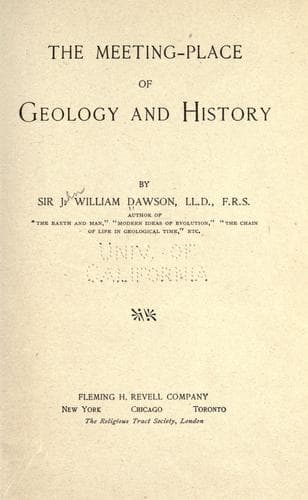
The Meeting-Place of Geology and HistoryDawson, John William, Sir
Religion
The Meeting-Place of Geology and History
Dawson, John William, Sir
Deluge; Prehistoric peoples
'We are,' says Lenormant, 'in a position to affirm that the account of
the Deluge is a universal tradition in all branches of the human family,
with the sole exception of the black race, and a tradition every-*where
so exact and so concordant cannot possibly be referred to an imaginary
myth. No religious or cosmogonic myth possesses this character of
universality. It must necessarily be the reminiscence of an actual and
terrible event, which made so powerful an impression upon the
imaginations of the first parents of our species that their descendants
could never forget it. This cataclysm took place near the primitive
cradle of mankind, and previous to the separation of the families from
whom the principal races were to descend, for it would be altogether
contrary to probability and to the laws of sound criticism to admit that
local phenomena exactly similar in character could have been reproduced
at so many different points on the globe as would enable one to explain
these universal traditions, or that these traditions should always have
assumed an identical form, combined with circumstances which need not
necessarily have suggested themselves to the mind in such a
connection.'[37]
[37] _Les Origines de l'Histoire._ Brown's translation.
On the geological side, the following may be accepted as a summary of
facts:[38]
[38] _Modern Science in Bible Lands_, 1888, pp. 244, 245, 251, 252.
'If the earliest men were those of the river gravels and caves, men of
the mammoth age or of the palæolithic or palæocosmic period, we can form
some definite ideas as to their possible antiquity. They colonised the
continents immediately after the elevation of the land from the great
subsidence which closed the pleistocene or glacial period, or in what
has been called the "continental" period of the post-glacial age,
because the new lands then raised out of the sea exceeded in extent
those which we now have. We have some measures of the date of this great
continental elevation. Many years ago, Sir Charles Lyell used the
recession of the Falls of Niagara as a chronometer, estimating their
cutting power as equal to one foot per annum. He calculated the
beginning of the process, which dates from the post-glacial elevation,
to be about thirty thousand years ago. More recent surveys have shown
that the rate is three times as great as that estimated by Lyell, and
also that a considerable part of the gorge was merely cleaned out by the
river since the pleistocene age. In this way the age of the Niagara
gorge becomes reduced to perhaps seven or eight thousand years. Other
indications of similar bearing are found both in Europe and America,
and lead to the belief that it is physically impossible that man could
have colonised the northern hemisphere at an earlier date. These facts
render necessary an entire revision of the calculations based on the
growth of stalagmite in caves, and other uncertain data which have been
held to indicate a greater lapse of time.
Public-domain text, read in full here on John Shaqi.
Reviews
Reviews
No reviews yet
Be the first to share your thoughts on this work.
Elsewhere in the archive
Join the Discussion
Join the discussion
Sign in to leave a comment or review.
Sign InorCreate an account