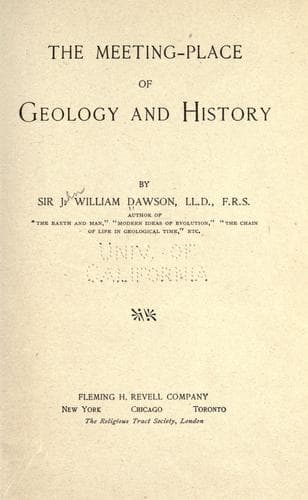
The Meeting-Place of Geology and HistoryDawson, John William, Sir
Religion
The Meeting-Place of Geology and History
Dawson, John William, Sir
Deluge; Prehistoric peoples
It is further evident that this tragic event must have occurred in that
Tigro-Euphratean region which was the Biblical site of Eden[43] and that
while the Sethite race presumably occupied the original home of Adam,
and adhered to that form of religion which is expressed in the worship
of Jahveh, the coming Redeemer and the expected 'Seed of the Woman,' the
other race spread itself more widely, probably attained to a higher
civilisation, in so far as art is concerned, in some of its divisions,
and sank to a deeper barbarism in others, while it retained the original
worship of God the Creator (Elohim). Hence the Sethite race is
designated as the sons of Adam (Beni ha Adam), the true and legitimate
children of the first man, and the Cainites as Beni Elohim, or sons of
God.[44] The mixture of these races produced the godless, heaven-defying
Nephelim, the Titans of the Old Testament, whose wickedness brought on
the diluvial catastrophe. These half-breeds of the antediluvian time
were in all probability the best developed, physically and perhaps
mentally, of the men of their period; and but for the Deluge they might
have become masters of the world.
[43] _Modern Science in Bible Lands_, chap. iv.
[44] That this is the true meaning of the expressions in Genesis vi. I
cannot doubt. See discussion of the subject in the work cited in
previous note.
This question of different races and religions before the Flood is,
however, deserving of a little farther elucidation. The names Elohim and
Jahveh are used conjointly throughout the Book of Genesis except in its
first chapter, and their mode of occurrence cannot be explained merely
on the theory of two documents pieced together by an editor. It has a
deeper significance than this, and one which indicates a radical
diversity between Elohists and Jahvists even in this early period. In
the earliest part of the human history, as distinguished from the
general record of creation, the two names are united in the compound
Jahveh-Elohim, but immediately after the fall Eve is represented as
attributing to, or identifying with, Jahveh alone the birth of her
eldest son--'I have produced a man, the Jahveh,' and which may mean that
she supposed Cain to be the promised manifestation of God as the
Redeemer. Accordingly Cain and Abel are represented as offering
sacrifice to Jahveh, and yet it is said in a verse which must be a part
of the same document, that it was not till the time of Enos, a grandson
of Adam, that men began to invoke the name of Jahveh. It would seem also
that this invocation of Jahveh was peculiar to the Sethites, and that
the Cainites were still worshippers of Elohim, the God of nature and
creation, a fact which perhaps has relation to the so-called physical
religion of some ancient peoples. Hence their title of Beni ha Elohim.
Thus the division between the Cainite and Sethite races early became
accentuated by a sectarian distinction as well. We may imagine that the
Public-domain text, read in full here on John Shaqi.
Reviews
Reviews
No reviews yet
Be the first to share your thoughts on this work.
Elsewhere in the archive
Join the Discussion
Join the discussion
Sign in to leave a comment or review.
Sign InorCreate an account