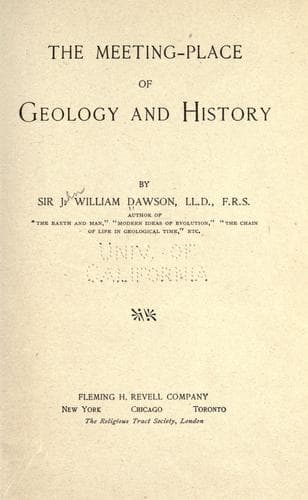
The Meeting-Place of Geology and HistoryDawson, John William, Sir
Religion
The Meeting-Place of Geology and History
Dawson, John William, Sir
Deluge; Prehistoric peoples
The incident of sending out birds to test the recession of the waters
deserves notice, because of its apparently trivial nature, because it
appears with variations in the Chaldean account, and because it has been
treated in a remarkably unscientific manner by some critics. It
indicates the uncertainty which would arise in the mind of the patriarch
because of the fluctuating decrease of the waters, and possibly also a
misty condition of the air preventing a distinct view of distant
objects. The birds selected for the purpose were singularly appropriate.
The raven is by habit a wanderer, and remarkable for power of flight
and clearness of distant vision. So long, therefore, as it made the ark
its headquarters, 'going and returning'[51] from its search for food, it
might be inferred that no habitable land was accessible. The dove, sent
out immediately after the raven,[52] is of a different habit. It could
not act as a scavenger of the waters and go and return, but could leave
only if it found land covered with vegetation. As a domesticated bird
also, it would naturally come back to be taken into the ark. Hence it
was sent forth at intervals of seven days, returning with an olive leaf
when it found tree tops above the water, and remaining away when it
found food and shelter. The Chaldean account adds a third bird, the
swallow--a perfectly useless addition, since this bird, if taken into
the ark at all, would from its habits of life be incapable of affording
any information. This addition is a mark of interpolation in the
Chaldean version, and proceeded perhaps from the sacred character
attached by popular superstition to the swallow, or from the familiar
habits of the bird suggesting to some later editor its appropriateness.
Singularly enough, the usually judicious Schrader, probably from
deficient knowledge of the habits of birds, fails to appreciate all
this, and after a long discussion prefers the Babylonian legend for
reasons of a most unscientific character, actually condemning the
perfectly natural and clear Biblical story as artificial and due to a
recent emendation. He says: 'When the story passed over to the Hebrews,
the name of the swallow has disappeared,' and 'it is only from the
Babylonian narrative that the selection of the different birds becomes
clear.' This little disquisition of Schrader is, indeed, one of the most
amusing instances of that inversion of sound criticism which results
when unscientific commentators tamper with the plain statements of
truthful and observant witnesses.
[51] Margin of Authorised Version; less fully, 'to and fro' in the text.
[52] There is no reason to suppose, as some have done, a hiatus here in
the narrative.
Public-domain text, read in full here on John Shaqi.
Reviews
Reviews
No reviews yet
Be the first to share your thoughts on this work.
Elsewhere in the archive
Join the Discussion
Join the discussion
Sign in to leave a comment or review.
Sign InorCreate an account