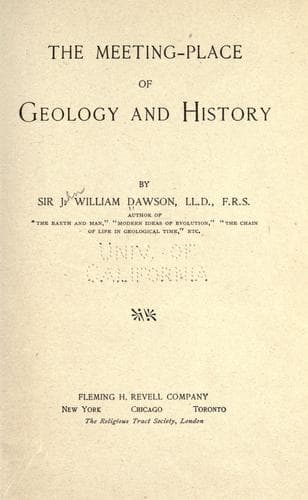
The Meeting-Place of Geology and HistoryDawson, John William, Sir
Religion
The Meeting-Place of Geology and History
Dawson, John William, Sir
Deluge; Prehistoric peoples
Regarding the Biblical Deluge as a record of a submergence of a vast
region of Eur-Asia and Northern Africa, at least, while no similar
catastrophe has been recorded subsequently, it is unquestionable that
submergences equally important have occurred again and again in the
geological history of our continents, and have been equally destructive
of animal life. It is true that most of these are believed to have been
of more slow and gradual character than that recorded in Genesis, but in
the case of many of them this is a very uncertain inference from the
analogy of modern changes; and it is certain that the post-glacial
submergence, which closed the era of palæocosmic man and his companion
animals, must have been one of the most transient on record. On the
other hand, we need not limit the entire duration of the Noachic
submergence to the single year whose record has been preserved to us.
Local subsidence may have been in progress throughout the later
antediluvian age, and the experience of the narrator in Genesis may have
related only to its culmination in the central district of human
residence. Finally, if man was really a witness of this last great
continental submergence, we cannot be too thankful that there were so
intelligent witnesses to preserve the record of the event for our
information.
It is needless, then, to enter into further details, though these are
sufficient to fill volumes if desired, in proof of the remarkable
convergence of history and geological discovery on the great Flood,
which now constitutes one of the most remarkable illustrations of the
points of contact of science proceeding on its own methods of
investigation and Divine revelation, preserving the records of ancient
events otherwise lost or buried under accretions of myth and fancy. I
have already endeavoured to show that the earliest race of palæocosmic
men, that of Canstadt, very fairly corresponds with what may have been
the characteristics of the ruder tribes of Cainites, and that if we
regard the Truchère skull as representing the Sethite people, we may
suppose the Cro-magnon race to represent the giants, or Nephelim, who
sprung from the union of the two pure types. I have also referred to the
possibility that the Truchère race, so little known to us as yet, may
have been a prot-Iberian people, possessing even before the Flood
domestic animals, agriculture, and some of the arts of life,
corresponding to what we find in the earliest postdiluvian nations. This
is, indeed, implied in the fact that the postdiluvian nations present
themselves to us at once with a somewhat advanced condition of the arts,
especially in Chaldea and in Egypt. Such possibilities may serve to
suggest to speculative archæologists that they cannot safely assume
that all antediluvian or palæolithic tribes were barbarous or
semi-brutal, or that there was a continuous development of humanity
without any diluvial catastrophe. It is also somewhat rash to carry back
Public-domain text, read in full here on John Shaqi.
Reviews
Reviews
No reviews yet
Be the first to share your thoughts on this work.
Elsewhere in the archive
Join the Discussion
Join the discussion
Sign in to leave a comment or review.
Sign InorCreate an account