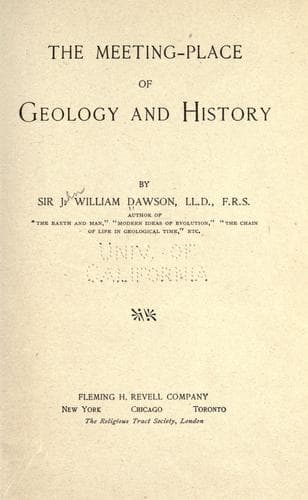
The Meeting-Place of Geology and HistoryDawson, John William, Sir
Religion
The Meeting-Place of Geology and History
Dawson, John William, Sir
Deluge; Prehistoric peoples
4. The Deluge may have been universal in so far as the area and
observation and information of the narrator extended. The story is
evidently told in the form of a narrative derived from eye-witnesses,
and this form seems even to have been chosen or retained purposely to
avoid any question of universality of the first and second kinds
referred to above. The same form of narrative is preserved in the
Chaldean legend. This fact is not affected by the doctrine held by some
of the schools of disintegrators, that the narrative is divisible into
two documents, respectively 'Jahvistic' and 'Elohistic.' I have
elsewhere[56] shown that there is a very different reason for the use of
these two names of God. But if there were two original witnesses whose
statements were put together by an editor, this surely does not
invalidate their testimony or deprive them of the right to have it
understood as they intended.
[56] _Modern Science in Bible Lands_, chap. iv.
It is thus evident that the whole question of 'universality' is little
more than a mere useless logomachy, having no direct relation to the
facts or to the credibility of the narrative.
There are also in connection with this question of universality certain
scientific and historical facts already referred to which we may again
summarise here, and which are essential to the understanding of the
question. Nothing is more certainly known in geology than that at the
close of the later tertiary or pleistocene age the continents of the
northern hemisphere stood higher and spread their borders more widely
than at present. In this period also they were tenanted by a very grand
and varied mammalian fauna, and it is in this continental age of the
later pleistocene or early modern time that we find the first
unequivocal evidence of man as existing on various parts of the
continents. At the close of this period occurred changes, whether sudden
or gradual we do not know, though they could not have occupied a very
long time, which led to the extinction of the earliest races of men and
many contemporaneous animals. That these changes were in part, at least,
of the nature of submergence we learn from the fact that our present
continents are more sunken or less elevated out of the water, and also
from the deposit of superficial gravels and other _detritus_ more recent
than the pleistocene over their surfaces. We are thus shut up by
geological facts to the belief in a Deluge geologically modern and
practically universal.
Public-domain text, read in full here on John Shaqi.
Reviews
Reviews
No reviews yet
Be the first to share your thoughts on this work.
Elsewhere in the archive
Join the Discussion
Join the discussion
Sign in to leave a comment or review.
Sign InorCreate an account