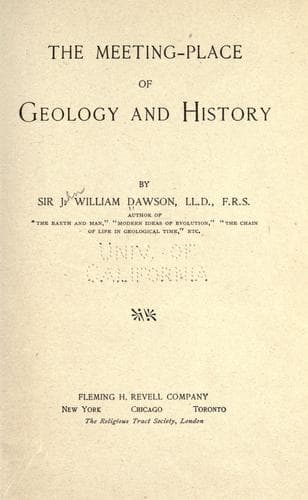
The Meeting-Place of Geology and HistoryDawson, John William, Sir
Religion
The Meeting-Place of Geology and History
Dawson, John William, Sir
Deluge; Prehistoric peoples
We have already seen how the Deluge story and the fate of the
antediluvians have interwoven themselves with the myths and
superstitions of the Old World. The six great gods of the Egyptian
pantheon represent the creative days, and the 'Sons of Horus' the
antediluvians. So we have the ten patriarchs or kings of the old
Chaldeans corresponding to those of Genesis, and the heaven-defying
Titans of the old mythologies representing the giants before the Flood.
Perhaps, however, no illustration of this is more patent or more
touching than that well-known one of Ishtar, the Astarte of the Syrians,
the Artemis of the Greeks, and who has been identified with the chief
female divinity of many other ancient nations, even with that Diana whom
'all Asia and the inhabited world worshippeth.'
The Chaldean deluge tablets for the first time introduce her to us as an
antediluvian goddess, and inform us that she is the deified mother of
men, the same with the Biblical Isha, or Eve. In the crisis of the
Deluge we are told, 'Ishtar spoke like a little child, the great goddess
pronounced her discourse. Behold how mankind has returned to clay. I am
_the mother who brought forth men_, and like the fishes they fill the
sea. The gods because of the angels of the abyss are weeping with me.'
Ishtar is thus the mother of men, herself deified and gone into the
heavens, but even there mourning over her hapless children. She may be a
star-goddess, or the moon may be her emblem; but for all that she
appears in this old legend as a deified human mother, with a mother's
heart yearning over the progeny that had sprung from her womb, and had
been nourished in her breast. It was this, more than her crescent or
starry diadem, that commended her worship to her children. Her
representative in Genesis, the first mother, Isha, or Eve, is no
goddess, but a woman. Yet is she the emblem of life and the mother of a
promised Redeemer of humanity, who is to undo the results of sin and to
restore the Paradise of God bruising the head of the great serpent who,
in the Chaldean as in the Hebrew story, represents the power of evil.
Ishtar has been represented as the bride of the god Tammuz, the
Adonis[61] of the Greeks, and whose worship was one of the idolatries
that led the women of Israel astray, 'weeping for Tammuz';[62] but it
now appears that, according to the oldest doctrine, she is his
mother,[63] and he was a 'keeper of sheep,' dwelling in Eden, or Idinu,
and murdered by his brother Adar, who is also a god, and more especially
the god of war. In short, the story of Ishtar, Tammuz, and Adar, the
parent of so many myths, is merely the familiar one of Cain and Abel.
Hence the belief that the murder of Tammuz was connected with the
Deluge, and hence the annual lamentation of the women for Tammuz when
the spring inundations swelled and reddened the waters of the streams--a
rite possibly even antediluvian, and commemorative of the mourning of
Public-domain text, read in full here on John Shaqi.
Reviews
Reviews
No reviews yet
Be the first to share your thoughts on this work.
Elsewhere in the archive
Join the Discussion
Join the discussion
Sign in to leave a comment or review.
Sign InorCreate an account