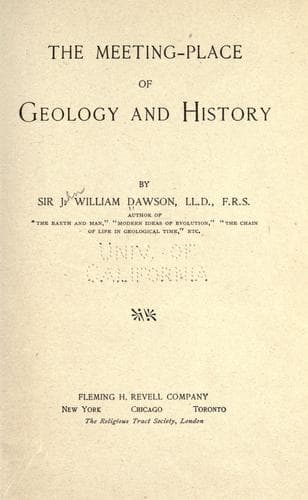
The Meeting-Place of Geology and HistoryDawson, John William, Sir
Religion
The Meeting-Place of Geology and History
Dawson, John William, Sir
Deluge; Prehistoric peoples
If they left any remains we should find these in caverns or rock
shelters, or in the old gravels belonging to this period which here and
there project through the alluvial plain. At one of these places, Jebel
Assart, near Thebes, General Pitt-Rivers has satisfied himself of the
occurrence of flint chips which may have been of human workmanship;[65]
but after a day's collecting at the spot, I failed to convince myself
that the numerous flint flakes in the gravel were other than accidental
fragments. If they really are flint knives they are older than the
period we are now considering, and must be much older than the first
dynasty of the Egyptian historic kings.[66] These gravels were indeed,
in early Egyptian times, so consolidated that tombs were excavated in
them. Independently of this case, I know of no trustworthy evidence of
the residence of the earliest men in Egypt. Yet we know that at this
time rude hunting tribes had spread themselves over Western Asia, and
over Europe as far as the Atlantic, and were slaying the mammoth, the
hairy rhinoceros, the wild horse, and other animals now extinct. They
were the so-called 'palæolithic' or historically antediluvian men,
belonging, like the animals they hunted, to extinct races, quite
dissimilar physically from the historical Egyptians. And yet in a recent
review of the late Miss Edwards's charming work, _Pharaohs, Fellahs, and
Explorers_, she was taken to task by an eminent Egyptologist for
statements similar to the above. On the evidence of two additional finds
of flint implements _on the surface_, he affirms the existence of man
in Egypt at a time when 'the Arabian deserts were covered with verdure
and intersected by numerous streams,' that is, geologically speaking, in
the early pleistocene or pliocene period, or even in the miocene!
[65] _Journal of Archæological Society_, 1881. Haynes's _Journal of the
American Academy of Sciences_.
[66] Dawson, _Egypt and Syria_, p. 149.
Singularly enough, therefore, Egypt is to the prehistoric annalist not
an old country--less old indeed than France and England, in both of
which we find evidence of the residence of the palæolithic cave men of
the mammoth age. Thus, when we go beyond local history into the
prehistoric past, our judgment as to the relative age of countries may
be strangely reversed.
Public-domain text, read in full here on John Shaqi.
Reviews
Reviews
No reviews yet
Be the first to share your thoughts on this work.
Elsewhere in the archive
Join the Discussion
Join the discussion
Sign in to leave a comment or review.
Sign InorCreate an account