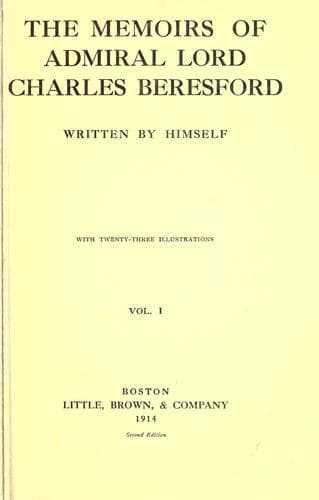
The Memoirs of Admiral Lord BeresfordBeresford, Charles William De la Poer Beresford, Baron
History
The Memoirs of Admiral Lord Beresford
Beresford, Charles William De la Poer Beresford, Baron
Admirals -- Great Britain -- Biography; Great Britain -- History, Naval -- 19th century
Of the other members of the Prince's suite I retain the most pleasant
recollections. Among them I especially recall Major-General Probyn
(afterwards General the Right Hon. Sir Dighton Macnaghten Probyn, V.C.,
etc. etc.); Major-General Sam Browne, V.C. (afterwards General Sir
Samuel James Browne, V.C., K.C.S.I., etc.); Major Bradford (afterwards
Sir Edward Ridley Colborne Bradford, Bart., K.C.S.I., G.C.V.O.);
Surgeon-General Fayrer (afterwards Sir Joseph Fayrer, Bart.); and Dr.
Russell (afterwards Sir William Howard Russell, C.V.O., LL.D.).
Major-General Probyn, of magnificent presence, black-bearded,
hawk-eyed, a hero of the Mutiny, was universally respected and beloved
by the native population, over {162} whom he owned a great influence.
He was one of the finest soldiers and most delightful companions it has
been my fortune to know. In 1876, he already had twenty-five years'
service, including the Trans-Indus frontier affair of 1852-57, the
Mutiny (in which his name was a terror), in China in 1860, in the
Umbeyla campaign of 1863. He was Colonel of Probyn's Horse, 11th King
Edward's Own Lancers; afterwards Keeper of the Privy Purse, Comptroller
and Treasurer of the Household of the present King when he was Prince
of Wales; and since 1901, extra Equerry to the King.
Probyn and I assisted at a surgical operation. A mahout had his hand
smashed; and we held him while the surgeon amputated his finger and
thumb.
Major-General Sam Browne, V.C., had served in the second Sikh war with
distinction, and during the Mutiny led the surprise attack upon the
rebels at Sirpura, at dawn upon 31st August, 1858. Almost
single-handed, he charged the guns, receiving the wound resulting in
the loss of his arm. For this service, he was awarded the V.C. During
the Prince's tour he represented the Indian Army; nor could a finer or
more efficient representative have been selected.
Major Bradford had performed gallant and distinguished service in the
Mutiny. He had lost an arm, under circumstances which may be worth
repetition. Together with a brother officer, Captain Curtis, and a
trooper, Bradford was tiger-shooting. Seated in a mechan
(tree-shelter), he wounded a tiger, breaking its back; his second
barrel missed fire; and Bradford fell from the mechan on the top of the
tiger, which seized him. Bradford thrust his fist down the beast's
throat; and while Curtis was trying to get another shot, the tiger
mangled Bradford's arm up to the shoulder. Curtis eventually killed
the animal. The party had a long and painful distance to traverse
before they reached help. Bradford's arm was amputated without
chloroform. In 1890, Bradford was appointed commissioner of police in
the Metropolis, at a time when there was a good deal of {163}
discontent in the Force, and speedily proved the worth of his
unrivalled experience and ability.
Public-domain text, read in full here on John Shaqi.
Reviews
Reviews
No reviews yet
Be the first to share your thoughts on this work.
Elsewhere in the archive
Join the Discussion
Join the discussion
Sign in to leave a comment or review.
Sign InorCreate an account