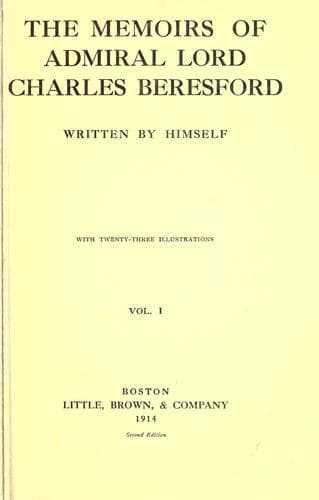
The Memoirs of Admiral Lord BeresfordBeresford, Charles William De la Poer Beresford, Baron
History
The Memoirs of Admiral Lord Beresford
Beresford, Charles William De la Poer Beresford, Baron
Admirals -- Great Britain -- Biography; Great Britain -- History, Naval -- 19th century
I had special reason to be grateful to Mr. John Ross, a British
merchant of Alexandria, who gave me every assistance in his power. He
knew every yard of the place. He gave me invaluable advice with regard
to the organisation of the city, obtained interpreters, and helped to
supply the troops, placing his stores at my disposal. He would have
dispensed with receipts for articles supplied, had I not insisted upon
his taking them. Mr. Ross supplied the whole Fleet with coal, fresh
meat, and all necessaries; his help was quite inestimable, his energy
and patriotism beyond praise; {196} but although he must have suffered
considerable losses, he received no recognition of any kind from the
Governnment except the naval medal.
Mr. Ross gave me great assistance also in parcelling out Mehemet Ali
Square among the country purveyors of produce, each of whom received a
permit, written in English and in Arabic, to occupy a certain space,
duly pegged out, in which to put up their booths. This measure
restored confidence. One old lady, a stout person of Levantine origin,
thought that the permit entitled her to perpetual freehold; and she
subsequently attempted to sue the Egyptian Government for damages,
producing my permit as evidence.
Upon first going ashore to restore order, I found whole streets blocked
with smouldering ruins. Putting my horse at one such obstacle, I
scrambled over it; and I had scarce reached the other side when a wall
fell bodily behind me, cutting off my escort, who had to fetch a
compass round the side streets to rejoin me.
Without taking the smallest notice of me or of my escort, men were
shooting at one another, quarrelling over loot, and staggering along,
laden with great bundles, like walking balloons. The streets were
speedily cleared of these rioters by the use of machine guns. The
method adopted was to fire the gun over their heads, and as they fled,
to run the gun round turnings and head them off again, so that they
received the impression that the town was full of guns. On no occasion
did I fire the gun _at_ them. The principles upon which order was
restored were to punish disobedience, to enlist labour and to pay for
it fairly.
The prisoners taken were organised in separate gangs set to work, and
paid less than the rest of the labourers! The most critical part of
the business of extinguishing fires and preventing incendiarism
occurred at the Tribunal, which was stored with property worth many
thousands of pounds. A fire-engine was purchased for its protection at
a cost of £160, 18s. 1d. The total expenses of the restoration or
{197} order were, I think, under £2000. During the fortnight I was on
shore, every station and port was visited at least once a day and twice
a night.
Public-domain text, read in full here on John Shaqi.
Reviews
Reviews
No reviews yet
Be the first to share your thoughts on this work.
Elsewhere in the archive
Join the Discussion
Join the discussion
Sign in to leave a comment or review.
Sign InorCreate an account