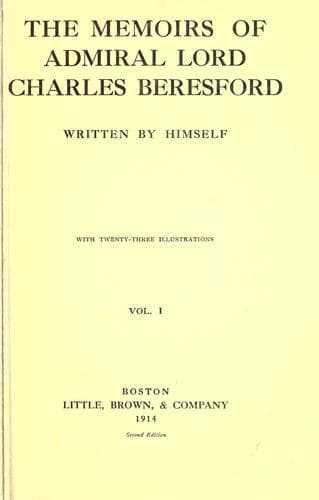
The Memoirs of Admiral Lord BeresfordBeresford, Charles William De la Poer Beresford, Baron
History
The Memoirs of Admiral Lord Beresford
Beresford, Charles William De la Poer Beresford, Baron
Admirals -- Great Britain -- Biography; Great Britain -- History, Naval -- 19th century
At the beginning of the year 1883 I was on my way out to India with
Lady Charles in the P. and O. s.s. _Malwa_. Proceeding into Ismailia
Lake, the _Malwa_ was rammed by another vessel which tried to cross the
_Malwa's_ bows. I was looking over the side of the _Malwa_ and I saw a
curious thing. I saw the colliding vessel rebound from the _Malwa_ and
strike her again. I ran up to the bridge, where the captain had
already given orders to stop the engines. The ship was sinking; it was
no time to stand upon ceremony; and I ventured to suggest to the
captain that he should put his engines full steam ahead, when he might
hope to beach the vessel, whereas if she stayed where she was, she
would infallibly go down in deep water. The captain, like a good
seaman, gave the order, and the chief engineer carried it into
execution with admirable promptitude. I went down into the engine-room
and found the water already rising through the foot-plates.
As the ship steamed towards the shore, settling down as she went, I
stood with Lady Charles on the bridge, telling her that, if the vessel
sank, I should throw her overboard--although she could not swim--and
should jump in after her. To which she merely replied, "That will be
very disagreeable!"
The ship was safely beached, though not before the water had risen to
my cabin. She was afterwards salved by the help of the Navy. H.M.S.
_Carysfort_, commanded by Captain H. F. Stephenson, C.B. (now Admiral
Sir Henry F. Stephenson, {210} G.C.V.O., K.C.B., Gentleman Usher of the
Black Rod), sent a carpenter and a working party; and they did
excellent service in the _Malwa_.
Our party went to Cairo, there to await the next steamer.
Hicks Pasha and his staff dined with us upon the night before they left
Cairo, upon their fatal expedition. Colonel W. Hicks had been
appointed by the Khedive chief of the staff of the Army of the Soudan.
In the following August he was appointed commander-in-chief. From
Cairo he went to Souakim, thence to Berber, and thence to Khartoum. On
the 28th April, he fought a successful action on the White Nile, south
of Khartoum, in which his Egyptian troops did well. In September,
Hicks left Duem with his staff and some 10,000 men and marched into the
desert, which swallowed them up. The whole army was exterminated by
the Mahdi's dervishes. Gordon said that the Mahdi built with the
skulls of the slain a pyramid.
I applied for permission to accompany Hicks Pasha, but my old friend
Lord Dufferin was determined that I should not go upon that hazardous
enterprise. I believe he telegraphed to the Government on the subject.
At any rate, he had his way, and so saved my life.
In October, before the news of the disaster had reached Cairo, the
British Army of Occupation had been reduced from 6700 men to 3000.
Subsequently, the British Government proceeded with the policy of
abandoning the Soudan, in one phase of which I was to bear my part.
Public-domain text, read in full here on John Shaqi.
Reviews
Reviews
No reviews yet
Be the first to share your thoughts on this work.
Elsewhere in the archive
Join the Discussion
Join the discussion
Sign in to leave a comment or review.
Sign InorCreate an account