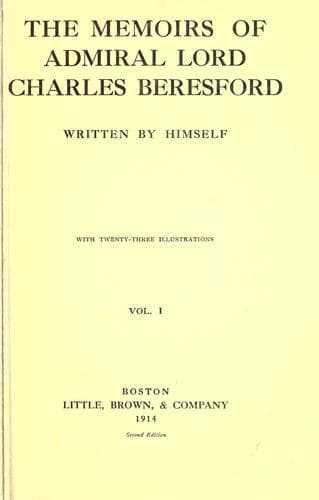
The Memoirs of Admiral Lord BeresfordBeresford, Charles William De la Poer Beresford, Baron
History
The Memoirs of Admiral Lord Beresford
Beresford, Charles William De la Poer Beresford, Baron
Admirals -- Great Britain -- Biography; Great Britain -- History, Naval -- 19th century
When we arrived in Cairo there were already 29 naval officers and 190
men, divided into several sections, at work along the Nile. These were
sent by Admiral Lord John Hay, commander-in-chief in the Mediterranean.
In addition, the Admiralty had appointed two or three senior officers,
among whom was Captain Boardman (afterwards Admiral F. R. Boardman,
C.B.). At Lord Wolseley's request, Boardman was placed in command of
the whole naval contingent, which had not hitherto been under either a
naval officer in chief command or the military authority. My own
position with regard to the naval contingent was simply that of Lord
Wolseley's representative.
While we were in Cairo I purchased for £24 my famous racing camel
Bimbashi. Buller also bought a camel, and we rode together daily. He
used to laugh till he nearly fell out of his saddle, when my camel ran
away with me through and over foot-passengers, donkeys, carriages and
dogs. I might haul Bimbashi's head round till it was under my knee,
and he was looking astern, and still he charged onwards.
{223}
The whale-boats designed to transport the expedition were then arriving
in large numbers. The total number was 800. They were similar to the
man-of-war 30-foot whaler, but fuller in the body to enable them to
carry more weight. Each boat was 30 feet long, with six feet six
inches beam, and two feet six inches draught, fitted for 12 oars, and
two masts with lug sails, and capable of carrying 10 soldiers, two
boatmen (Canadian _voyageurs_), 1000 rations and ammunition.
There was a story current when the boats were struggling up the Nile,
that one of them, manned by a sergeant and eight soldiers, but without
a _voyageur_ on board, having run athwart a rock and upset, a soldier
observed to the sergeant that "the cove who sent nine men in a boat
with 1000 rations must have been this here journey before!"
There were also to be provided eight steam pinnaces, two stern-wheel
paddle boats, and a number of hired Egyptian Government steamers. The
whale-boats as they arrived were sent, first, by rail and river to
Assiout. Thence they were towed to Assouan, where is the First
Cataract. Here they were either railed on trucks, or hauled through
the rapids to Shellal, eight miles up. From Shellal to Wady Halfa, 200
miles farther, was plain sailing. At Wady Halfa is the Second Cataract
and the formidable rapid of Bab-el-Kebir, or the "Great Gate."
Public-domain text, read in full here on John Shaqi.
Reviews
Reviews
No reviews yet
Be the first to share your thoughts on this work.
Elsewhere in the archive
Join the Discussion
Join the discussion
Sign in to leave a comment or review.
Sign InorCreate an account