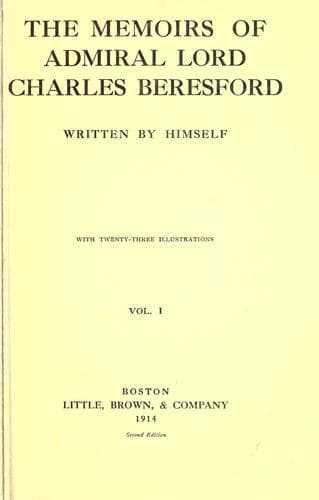
The Memoirs of Admiral Lord BeresfordBeresford, Charles William De la Poer Beresford, Baron
History
The Memoirs of Admiral Lord Beresford
Beresford, Charles William De la Poer Beresford, Baron
Admirals -- Great Britain -- Biography; Great Britain -- History, Naval -- 19th century
By the 6th November, 60 boats had left Gemai with the Sussex regiment
on board. The river was then falling so swiftly that a new course for
the boats must be found almost every day. Hitherto the boats had been
passed through the Cataract almost without a scratch or the loss of a
single article of gear. Now the rocks began to show through the surf
in the Bab.
A boat was smashed. We caught her lower down; and with 200 men
portaged her over a rocky hill, across the neck of land formed by the
curve of the Bab, then laid her keel upwards across two other boats,
and so floated, took her up to Gemai dockyard. I was the more pleased
with this piece of salvage, because everyone said it was impossible to
save the boat. The last nine boats, after being emptied of all gear,
were hauled clean over the rocks by main force. They came prettily
lipping through the boiling torrent from rock to rock, taking the blows
upon keel and bilge pieces, so that they were scarcely damaged.
Early in October, foreseeing that, as the water fell, the Bab-el-Kebir
would become impracticable, I had designed a scheme for a portage. The
alternative would have been to entrain the boats from Wady Halfa to
Sarras, an expedient which, as the whole of the train service was
required to carry provisions, would have involved immense delay.
My plan was to haul the boats up to the entrance of the Bab and then to
carry them across the neck of land formed by the curve of the Bab, a
distance of 2488 yards, which required 400 men, who should be divided
into sections of 40 to each boat. The boat was hauled on shore, her
masts, oars, and poles laid on the ground to serve as bearers; the boat
was {232} laid on these keel uppermost, and was then lifted and
carried, the masts, oars, and poles resting on the men's shoulders, and
other men supporting the boat by resting thwarts and gunwale on their
shoulders. My scheme was at first received with incredulity by all
except Lord Wolseley. But I made a trial trip with 30 men, and had the
boat across the portage, including six stoppages for rest, and in the
water with all her gear without a scratch, in an hour and twenty
minutes. The passage of Bab-el-Kebir, low as the water had become,
would have taken at least six hours, with great risk of disaster.
Now, having hauled the last nine boats through, over the rocks, the
portage scheme came into operation; and on the 6th November I closed
the Bab, and used the portage, by means of which alone it was made
possible to continue the supply of boats at the same rate.
Thenceforward we were able to put the boats through quicker than they
were supplied.
Many of the boats were poisonous to handle, as their matting was
infested with scorpions.
Public-domain text, read in full here on John Shaqi.
Reviews
Reviews
No reviews yet
Be the first to share your thoughts on this work.
Elsewhere in the archive
Join the Discussion
Join the discussion
Sign in to leave a comment or review.
Sign InorCreate an account