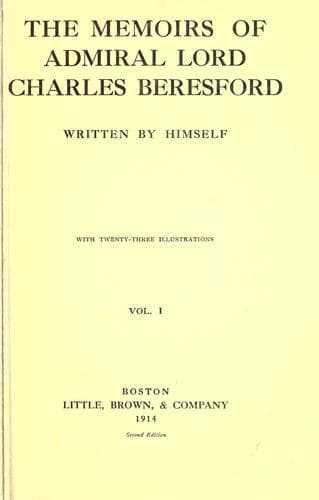
The Memoirs of Admiral Lord BeresfordBeresford, Charles William De la Poer Beresford, Baron
History
The Memoirs of Admiral Lord Beresford
Beresford, Charles William De la Poer Beresford, Baron
Admirals -- Great Britain -- Biography; Great Britain -- History, Naval -- 19th century
Fighting every mile of the great river pouring down from Khartoum, we
on the Cataracts had no news of Gordon. All we knew was that there was
need to hurry, hurry all the way. At such times as the mail from home
arrived upon a dyspeptic camel, we got scraps of news of home affairs.
People who knew much more than Lord Wolseley, were saying he ought to
have taken the Souakim-Berber route instead of the Nile route. I said
then, as I say now, he had no choice. At this time of crisis, when the
Navy was dangerously inadequate, one political party was screaming
denunciations against "legislation by panic." Encouraging to sailors
and soldiers sweating on service! But we knew what to expect. I
observe that in a private letter written in December, 1884, from the
banks of the Nile, at the end of a long day's work with the boats, I
said, "Both sides are equally to blame for the defective state of the
Navy. Tell ---- and ---- not to be unpatriotic and make the Navy a
party question, or they will not do half the good they might."
{243}
We came to Ambigol to find the boats had been cleared by Alleyne of the
Artillery. I was able to improve the organisation there, and to give
help along the river I was in time to save three boats. At Dal, I laid
lines along the centre of the two and a half miles rapid, so that in
calm weather the boats could haul themselves through.
In the meantime, the Naval Brigade of which Lord Wolseley had ordered
me to take command, had been selected, at my request, by Captain
Boardman.
On 19th December, my first division came to Dal. Up they came, all
together in line ahead, under all possible sail, using the boat awnings
as spinnakers. They had sailed up the rapids where the other boats
were tracking; and the soldiers cheered them as they went by. There
was not a scratch on any boat, nor a drop of water in any of them.
Every cargo was complete in detail, including machine guns, ammunition,
oil and stores. Had I not a right to be proud of the seamen? I put an
officer at the helm of each boat, and told them to follow me through
Dal Cataract; and led them through, so that the same night the boats
were reloaded with the gear and cargo which had been portaged, and were
going on. The passage of Dal Cataract usually occupied three days.
I sent on the first division, and stayed at Dal to await the arrival of
the second, in order to get all my men together. As it happened, I did
not see it until it reached Korti. On 21st December it had left
Sarras, bringing oil and stores to be used in the Nile steamers of
which I was to take charge. For by this time I had been informed of
Lord Wolseley's intention to send the Naval Brigade with the Camel
Corps to make a dash across the Bayuda Desert to Metemmeh. The Naval
Brigade was then to attack Khartoum in Gordon's steamers, while the
Camel Corps attacked it by land.
Public-domain text, read in full here on John Shaqi.
Reviews
Reviews
No reviews yet
Be the first to share your thoughts on this work.
Elsewhere in the archive
Join the Discussion
Join the discussion
Sign in to leave a comment or review.
Sign InorCreate an account