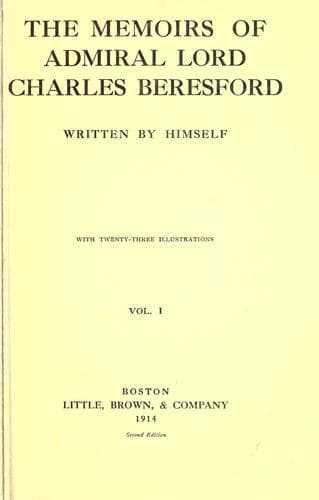
The Memoirs of Admiral Lord BeresfordBeresford, Charles William De la Poer Beresford, Baron
History
The Memoirs of Admiral Lord Beresford
Beresford, Charles William De la Poer Beresford, Baron
Admirals -- Great Britain -- Biography; Great Britain -- History, Naval -- 19th century
The official account gives the loss of the enemy at 1100 in the
vicinity of the square.
Nearly half the British rifles jammed, owing to the use of leaf
cartridges. The Remington rifles used by the Mahdi's soldiers had
solid drawn cartridges which did not jam. During the action of Abu
Klea the officers were almost entirely employed in clearing jammed
rifles passed back to them by the men. The British bayonets and
cutlasses bent and twisted, the result of a combination of knavery and
laziness on the part of those who were trusted to supply the soldier
with weapons upon which his life depends. The bayonets were blunt,
because no one had thought of sharpening them. The spears of the Arabs
were sharp like {268} razors. The cutlasses of the Naval Brigade were
specially sharpened.
I noticed that when a soldier was killed, a bluejacket always
endeavoured to secure his bayonet; and that when a sailor was killed, a
soldier always tried to take his hat, preferring it to the Army helmet.
The official report of Sir Charles Wilson states the total number of
the enemy to have been from 9000 to 11,000, consisting of men from
Berber, Metemmeh, Kordofan, and 1000 men of the Mahdi's army. Of the
total number, it was estimated that 5000 or 6000 attacked. The British
numbered something over 1200 men; but, these being in square, the
weight of the attack fell upon no more than about 300 men. There were
342 men of the Royal Artillery on the front face of the square; 235 men
on the left flank, reinforced when the charge came by some of the Naval
Brigade and a company from the rear face; 300 men and the Naval
Brigade, between 40 and 50 strong, on the rear face; and 307 men on the
right flank. The centre was a solid mass of camels. This thin
framework of men, forced back upon the camels, resisted the tremendous
impact of thousands of frenzied fanatics who knew not fear, and whom
nothing stopped but death.
I cannot better describe the result than by quoting the words of
Colonel the Hon. Reginald Talbot, 1st Life Guards, who commanded the
Heavy Camel Regiment at Abu Klea (_Nineteenth Century_, Jan. 1886):
"It was an Inkerman on a small scale--a soldiers' battle; strength,
determination, steadiness, and unflinching courage alone could have
stemmed the onslaught."
It was a soldiers' battle, because the attack was sudden; it came
before the square was formed; and in the stress and tumult orders were
useless.
[Illustration: THE AUTHOR, 1912]
{269}
CHAPTER XXIX
THE SOUDAN WAR (_Continued_)
VII. THE FIGHT TO REACH THE RIVER
Public-domain text, read in full here on John Shaqi.
Reviews
Reviews
No reviews yet
Be the first to share your thoughts on this work.
Elsewhere in the archive
Join the Discussion
Join the discussion
Sign in to leave a comment or review.
Sign InorCreate an account