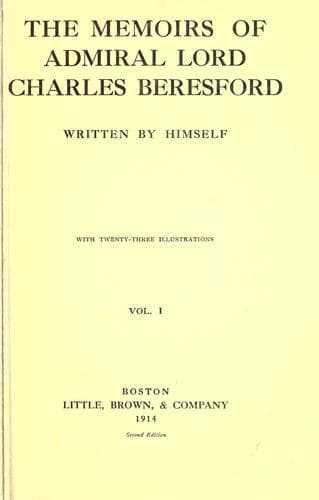
The Memoirs of Admiral Lord BeresfordBeresford, Charles William De la Poer Beresford, Baron
History
The Memoirs of Admiral Lord Beresford
Beresford, Charles William De la Poer Beresford, Baron
Admirals -- Great Britain -- Biography; Great Britain -- History, Naval -- 19th century
I sat on an ammunition box and shivered. The wound upon my finger,
where the Arab's spear had cut it, though slight, was
disproportionately painful. Lieutenant Douglas Dawson (of the
Coldstream Guards) came to me and asked me if I had any tobacco. I
told him that my tobacco, together with my field-glasses, had departed
into the desert with my steed County Waterford, which had run away.
Dawson had six cigarettes, of which he gave me three. I would
cheerfully have given a year's income for them, as {271} I told him.
We agreed that it was hard to have to die without knowing who had won
the Derby.
At about seven o'clock next morning (18th January) the convoy returned
with the rest of the camels and the commissariat. We had our first
meal for some thirty-six hours. Then we went to work to build a fort
in which to leave the wounded, and to prepare for the march to the
river, some 25 miles distant. A burying party went back to the field
of Abu Klea and interred our dead. Some prisoners captured by the
convoy on its way back to the camp, reported that Omdurman had fallen;
but the information was not made generally known. I did not hear it
until we reached Metemmeh.
Sir Herbert Stewart then determined to reach the Nile before next
morning. A small detachment of the Royal Sussex was left to guard the
wounded. The column marched about 3.30 p.m. It was a desperate
venture, for the men had had no sleep for two nights, had fought a
battle in between, had suffered agonies of thirst and the exhaustion of
hunger. But Sir Herbert Stewart had learned from the prisoners that
the enemy who had fought at Abu Klea were no more than the advanced
guard of the main body, which would probably come out from Metemmeh to
meet us, and that the fall of Omdurman had released a number of the
Mahdi's army; and the general wished to reach the river before fighting
again. He hoped to be upon the Nile before daylight. In any event,
the enterprise of the Desert Column was a forlorn hope; and by this
time we all knew it.
Cameron, war correspondent of _The Standard_, came to me with a very
grave face. He was not alarmed for his own safety, for he was a most
gallant man; but he feared for the Column.
"Lord Charles," he said, "have you any influence with General Stewart?
If so, for God's sake implore him not to go on without reinforcements.
I know these people and he does not."
{272}
The next time I saw poor Cameron was upon the following day, when he
was lying with a bullet-hole in his forehead, dead.
Public-domain text, read in full here on John Shaqi.
Reviews
Reviews
No reviews yet
Be the first to share your thoughts on this work.
Elsewhere in the archive
Join the Discussion
Join the discussion
Sign in to leave a comment or review.
Sign InorCreate an account