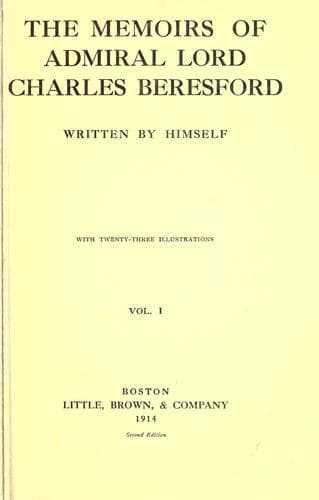
The Memoirs of Admiral Lord BeresfordBeresford, Charles William De la Poer Beresford, Baron
History
The Memoirs of Admiral Lord Beresford
Beresford, Charles William De la Poer Beresford, Baron
Admirals -- Great Britain -- Biography; Great Britain -- History, Naval -- 19th century
Sir Charles then sent Captain Trafford forward with the Royal Sussex,
Khashm-el-Mus and most of the Soudanese, while Sir Charles himself
remained with 30 men and one gun. They maintained a steady and a
useful fire until sunset, when they marched after the rest of the party.
Meantime, Mr. Benbow, down below, went on with his work.
{303}
It was about two o'clock when the artificers joined him, so that he had
already been toiling single-handed, except for the leading stoker, for
three hours. After another three hours, at five o'clock, the plate and
bar were made, the holes drilled in them and in the boiler, and the
threads cut upon the bolts and nuts. But the boiler was still so hot,
that it was impossible for a man to be in it, and the plate could not
be fixed, because it was necessary to pass the bolts through the plates
from inside the boiler. Mr. Benbow pumped cold water into the boiler
and out again once or twice; but by 6 o'clock the heat was still too
great for a white man to endure. We smeared a negro boy with tallow,
and I promised him a reward if he would go into the boiler. He was
delighted. He was lowered down, to climb out again faster than he went
in. After a short pause, he had another try. This time, in a frying
heat that only a black skin could bear, he stayed inside, passing the
bolts through, while Mr. Benbow caulked plates and bolts and screwed
them home. The boy was none the worse in body and richer in
possessions than ever in his life. By seven o'clock the job was done.
You can see what it was for yourself; for the plate is now in the
Museum of the Royal Naval College, Greenwich. Rear-Admiral Sir Colin
Keppel (sub-lieutenant in 1885), writing to me on the subject, says,
"When in command of the gunboats under Lord Kitchener in 1898, on our
way to Fashoda, about 300 miles above Khartoum on the White Nile, I
again came upon our old _Safieh_, then again in the hands of the
dervishes, with whom we had a short action. The first thing I did
afterwards was to go down below (I knew where to look!) and found the
patch which old Benbow had put on more than 13 years before."
Lord Kitchener afterwards had the plate cut out, and he very kindly
sent it to me.
By ten o'clock that night, the boiler was repaired and the fires were
laid. In the meantime, as soon as the twilight fell that evening, the
fire from the fort slackened. {304} It was my object to delude the
enemy into the belief that we had abandoned the steamer; for, if they
thought she was empty, they would not fire upon her, lest they should
damage an invaluable prize. Moreover, did the enemy suppose that we
were staying by the ship, they would during the night shift a gun from
the fort, dragging it along the bank to a point abreast of the steamer;
whence they could see the vessel looming on the water, whereas we in
the steamer could not see them; whence the range was no more than about
80 yards; and whence a single hit would disable us.
Public-domain text, read in full here on John Shaqi.
Reviews
Reviews
No reviews yet
Be the first to share your thoughts on this work.
Elsewhere in the archive
Join the Discussion
Join the discussion
Sign in to leave a comment or review.
Sign InorCreate an account