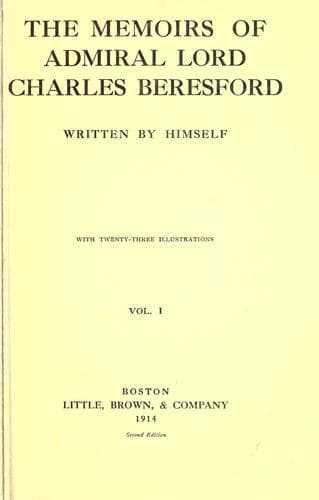
The Memoirs of Admiral Lord BeresfordBeresford, Charles William De la Poer Beresford, Baron
History
The Memoirs of Admiral Lord Beresford
Beresford, Charles William De la Poer Beresford, Baron
Admirals -- Great Britain -- Biography; Great Britain -- History, Naval -- 19th century
"If the Dervishes at Wad Habeshi had succeeded in capturing the
steamer, there is no doubt Nejumi would have hastened his march and
would have intercepted the English before they could have got away from
Gubat, but instead of that he halted when he heard of Wad Faid's death,
and delayed some days in consequence at Wad Bishara and at Gereishab.
He had a very large force with him ...
"(Signed) MURABEK WAD EL TILB"
{311}
The second extract is translated from the German of Father Orhwalder,
long a prisoner of the Mahdi:
"... It is an undoubted fact that Lord Charles Beresford's gallant
action at Wad Habeshi was the means of saving the lives of Sir Charles
Wilson and his party, who would have suffered a like fate to that of
Colonel Stewart and his companions, and it is an equally undoubted fact
that the Mahdi's success at Khartoum shook the fidelity of the
Shagiyeh, but Lord Charles Beresford's victory at Wad Habeshi had the
effect of making Nejumi dread meeting the English on the river, and
decided him to attack them on the desert.
"Lord Charles Beresford deserves the credit of having effected this and
was thus the means of saving the entire British force.
"(Signed) DON GUISEPPE ORHWALDER
"(23_rd February_, 1893)"
It is obvious that the estimation of the conduct of the officers and
men who fought at Wad Habeshi remains unaffected by the results of the
action, which were neither definitely contemplated nor clearly
foreseen. And the evidence I have quoted being irrelevant, strictly
speaking, to any criticism of the action itself, is here cited, not in
order to enhance the credit of the officers and men concerned but, for
the sake both of its intrinsic interest, and for the purpose of
illustrating, incidentally, the methods occasionally adopted under the
system controlling the Royal Navy.
The effect of the action at Wad Habeshi exemplifies the extraordinary
potency of the element of chance in war. Under what conceivable theory
of tactics could it have been maintained that a penny steamer had the
smallest chance of rescuing a detachment isolated in a hostile country,
upon condition of twice engaging a powerful battery at short range, and
twice defeating its garrison of sixty or a hundred to one? Or what
self-respecting tactician would have {312} predicted that in the
extremely improbable event of success, its effect would have been to
check, even momentarily, the advance by land of the main force of the
enemy?
Public-domain text, read in full here on John Shaqi.
Reviews
Reviews
No reviews yet
Be the first to share your thoughts on this work.
Elsewhere in the archive
Join the Discussion
Join the discussion
Sign in to leave a comment or review.
Sign InorCreate an account