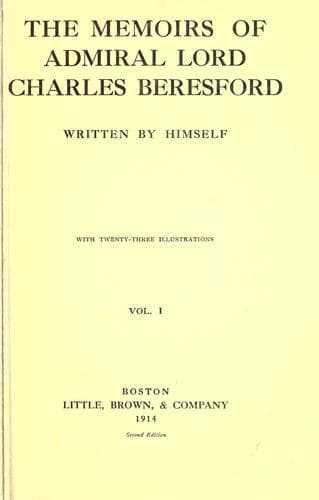
The Memoirs of Admiral Lord BeresfordBeresford, Charles William De la Poer Beresford, Baron
History
The Memoirs of Admiral Lord Beresford
Beresford, Charles William De la Poer Beresford, Baron
Admirals -- Great Britain -- Biography; Great Britain -- History, Naval -- 19th century
Lord Wolseley's dispatch instructed Sir Redvers Buller to make every
preparation for the evacuation of Gubat and the withdrawal of the
Column. At the same time, its tenor left a certain discretion to
Buller; who, replying to it in a private letter carried by the
returning messenger to Lord Wolseley, "spoke," says Colonel Colville,
in his official _History of the Sudan Campaign_, "hopefully of the
situation." I think the presence of the Royal Irish, in magnificent
condition, suggested to Buller that he could fight anybody anywhere.
In fact, when Sir Redvers came in to Gubat on 11th February, he wanted
to remain and fight. At his request, I stated to him my view of the
situation; which was, briefly, that unless we departed swiftly, we
should be eaten up by the enemy, who were known to be advancing in
immense force. I also reported officially that until the Nile rose,
the two steamers remaining to us were practically useless: a
consideration which proved conclusive. Sir Redvers Buller's dispatch,
dated at Gubat 12th February, and addressed to {319} the chief of
staff, describes the conclusions to which he came after having
carefully reviewed the situation (_History of the Sudan Campaign_--Part
II. p. 56). The camels were greatly reduced in number and were nearly
worn out; but if the Column were to attempt any further enterprise, the
camels must be sent to Jakdul and back to bring supplies, a journey
which would take at least ten days. This circumstance was virtually
conclusive. Sir Redvers adds: "I regret to have to express now an
opinion different to that which I expressed to Lord Wolseley in a
letter dated the night of the 10th instant; but when I then wrote, I
was not aware of the condition of the steamers and of the fact that the
big one could not pass a sandbank 25 miles below this. Lord C.
Beresford considers it doubtful if the other one can either.... Since
writing this I am confirmed in my opinion by the news that Mohammed
Ahmed (the Mahdi) left Khartoum _en route_ here on the 9th instant."
[Illustration: FIELD-MARSHAL THE RT. HON. VISCOUNT WOLSELEY, K.P.,
P.C., G.C.B., G.C.M.G., D.C.L., LL.D., O.M. 1833-1913]
In the meantime, Lord Wolseley had ordered the River Column to halt on
its way. On the 10th, General Earle, in command of the River Column,
had been killed at the action of Kirbekan. Lord Wolseley, until he
received Sir Redvers Buller's account of the desperate condition of the
River Column--deprived of transport, encumbered with wounded, short of
stores (owing to bad packing), and without boots--retained his
intention of effecting a junction of the two columns at Berber. At the
end of the third week in February that scheme was necessarily
abandoned. The River Column was recalled; and Buller, then on his way
back with the Desert Column, was instructed to return direct to Korti.
Public-domain text, read in full here on John Shaqi.
Reviews
Reviews
No reviews yet
Be the first to share your thoughts on this work.
Elsewhere in the archive
Join the Discussion
Join the discussion
Sign in to leave a comment or review.
Sign InorCreate an account