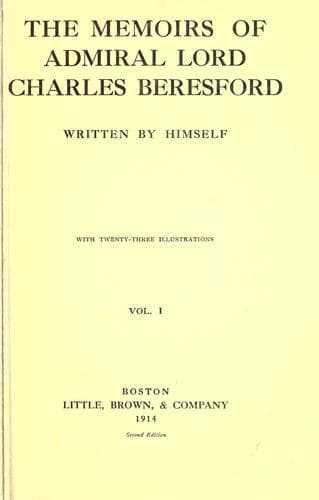
The Memoirs of Admiral Lord BeresfordBeresford, Charles William De la Poer Beresford, Baron
History
The Memoirs of Admiral Lord Beresford
Beresford, Charles William De la Poer Beresford, Baron
Admirals -- Great Britain -- Biography; Great Britain -- History, Naval -- 19th century
Colonel Talbot had been continuously employed upon the difficult and
arduous convoy duty since the arrival of the Desert Column at Gubat on
the 21st. Two days later Talbot started to return to Jakdul to fetch
supplies. Not he nor his men nor his camels had a day's rest from the
8th January, when the Desert Column left Korti, till the 27th, when the
convoy was back again at Jakdul. The convoy reached Gubat on the 31st
January; next day came the news of the fall of Khartoum; and the same
evening the convoy marched again for Jakdul with sick and wounded.
From Jakdul it returned with Sir Redvers Buller; arrived at Gubat on
the 11th February; and started again on the 13th, {323} as already
related, with another party of sick and wounded. On the way back to
Korti, Colonel Talbot, without engineers or commissariat, constructed a
camp and built forts at Megaga Wells, where the main body, including
the Naval Brigade, joined his convoy on 2nd March.
After Colonel Talbot's convoy had left Gubat on 13th February, I
disposed of the poor old _Safieh_ and the _Tewfikiyeh_, lest upon our
departure they should be taken by the enemy. The six brass guns were
spiked and thrown overboard, the ammunition was destroyed, the
eccentric straps were removed from the machinery, and finally the
valves were opened and the vessels sunk.
Then came the sad destruction of the stores for which we had no
transport. The number of camels would only suffice to carry rations
for three days, by the end of which the Column would have arrived at
Abu Klea, where were more stores. When Colonel Talbot's convoy of
supplies reached Gubat two days previously, the garrison had for ten
days been living on short rations: nevertheless, more than half of what
he brought must be destroyed. Count Gleichen (_With the Camel Corps up
the Nile_) says that "19,000 lbs. of flour, 3000 lbs. of biscuit,
21,220 lbs. of beef, 900 lbs. of bacon, 1100 lbs. of tea, oatmeal,
preserved vegetables, coffee, and all sorts of stores were pierced and
thrown into the river"--an example of waste in war resulting from
deficient transport.
Some of the medical comforts, small bottles of champagne and port, were
distributed. One among us--I think his name was Snow--took a bottle of
wine and swore he would keep it till he drank it in Khartoum. _And he
did_. He went into Khartoum with Kitchener thirteen years afterwards,
and drank his libation in the conquered city.
That incident reminds me that, when I went with the party of members of
the House of Commons to Russia in 1912, a Russian farmer sent a note to
the British admiral, of whom he said he had heard, together with a
bottle containing mustard which he had grown, and which he sent {324}
as a token that the aforesaid British admiral would give his enemies
mustard when he met them; for, said the farmer, the enemies of England
would certainly be the enemies of Russia. I have that bottle of
mustard.
Public-domain text, read in full here on John Shaqi.
Reviews
Reviews
No reviews yet
Be the first to share your thoughts on this work.
Elsewhere in the archive
Join the Discussion
Join the discussion
Sign in to leave a comment or review.
Sign InorCreate an account