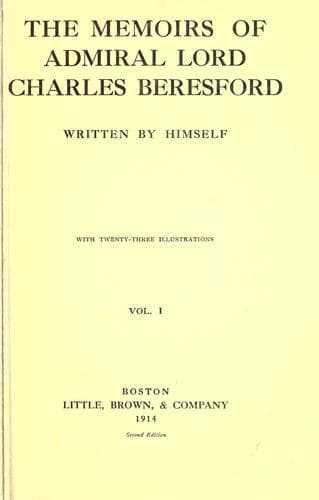
The Memoirs of Admiral Lord BeresfordBeresford, Charles William De la Poer Beresford, Baron
History
The Memoirs of Admiral Lord Beresford
Beresford, Charles William De la Poer Beresford, Baron
Admirals -- Great Britain -- Biography; Great Britain -- History, Naval -- 19th century
In every vessel there are improvements to be made which, perhaps
trifling in themselves, greatly add to the {365} welfare of the
officers and ship's company. At that time, for instance, the
arrangements for the stokers were so bad, that there was only one bath
available for twenty men. My recommendation was that tubs of
galvanised iron should be supplied, fitting one into another in nests,
so that the extra baths occupied less space than the one regulation
bath. I also had lockers of lattice-work supplied for the stokers'
dirty clothing, instead of closed and insanitary lockers. It is true
that at first the men objected to the open-work, because their pipes
dropped through it. Again, the hatchway ladders were made with sharp
nosings, against which the men injured their legs; and I suggested that
these should be formed with rounded nosings instead. A ship of war is
naturally uncomfortable; but why make it unnecessarily disagreeable?
At that time, too, the rate of second-class petty officer did not exist
among the stokers. The result was that if a leading stoker was
disrated he was reduced to stoker. For this reason, I urged the
institution of the rate of second-class petty officer stoker, a reform
which was eventually instituted. Some years afterwards, the rate of
second-class officer was abolished altogether, a retrograde measure
which I believe to be injurious.
When a petty officer loses his rate in consequence of a mistake or a
lapse, he should be enabled to recover it by good behaviour.
One of my countrymen on board, whom we will call Patrick, an able
seaman of long service, perpetually failed to attain to the rating of
petty officer owing to his weakness for strong waters. In other
respects he was admirably qualified to rise. I sent for him, told him
I would give him a chance, and made him a second-class petty officer.
I believe that he succumbed once or twice, and that the commander let
him off. But one fine day Patrick returned on board from leave ashore,
fully attired--cap, coat, boots and socks--with the single exception of
his trousers. The case having been officially reported to me, I had up
the delinquent before the assembled petty officers. I made it a rule
{366} not to disrate a petty officer in the presence of the ship's
company.
The charge having been duly read, I asked Patrick what he had to say on
the subject.
"Do you moind now, sir," says Pat, "that I was drunk the same day last
year?"
I told him I did not remember anything of the sort.
"Well, sir," continued Patrick, unabashed, "to tell you the truth, 'tis
my mother's birthday, and I had a drop of drink taken."
I told him that it was impossible to allow petty officers to disgrace
the ship by coming on board without their trousers; that I should take
away his petty officer's rate, but that I would leave him his badges.
Public-domain text, read in full here on John Shaqi.
Reviews
Reviews
No reviews yet
Be the first to share your thoughts on this work.
Elsewhere in the archive
Join the Discussion
Join the discussion
Sign in to leave a comment or review.
Sign InorCreate an account