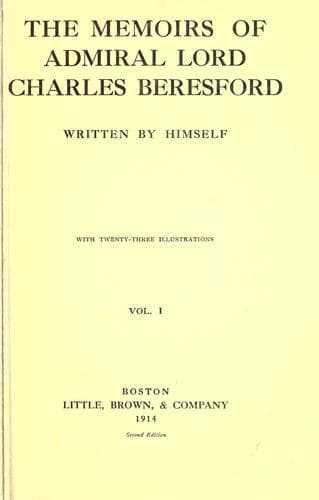
The Memoirs of Admiral Lord BeresfordBeresford, Charles William De la Poer Beresford, Baron
History
The Memoirs of Admiral Lord Beresford
Beresford, Charles William De la Poer Beresford, Baron
Admirals -- Great Britain -- Biography; Great Britain -- History, Naval -- 19th century
II. MY TWO FAITHFUL SERVANTS
They came to me first in the _Galatea_, so that their story may fitly
be related in this place. Tom Fat the China boy came to me at Kowloon.
He was brought to me by his uncle, who desired to dispose of his
nephew, for a consideration. The consideration was £5. Lest I should
be accused of Chinese slavery--and anything is possible in these
days--I should explain that the fiver was not the price of Tom Fat, but
was in the nature of a delicate compliment paid to his uncle. Tom was
a free boy; he was entered in the ship's books as my servant, at so
much wages per month. Not that he valued his wages particularly; he
had wider views. He was an invaluable servant, clever, orderly,
indefatigable and devoted. I attired him in gorgeous silks, and he
bore my crest with perfect unassuming dignity. He kept my purse, and
expended my money with prudence, even with generosity. When I wanted
money, Tom Fat had plenty of ready cash. I sometimes wondered how it
was that he always seemed to be provided with a margin, for I was not
conscious of practising economy. The fact was, I was careless in those
days, and kept no accounts. It was not until he had been in my service
for some years, that I discovered the secret of his wealth. It was
simple enough. He was in the habit of forging cheques. Altogether, he
forged cheques for nearly twelve hundred pounds. How much of that
amount he kept for himself I {83} never knew; but it is certain that a
great deal of it he spent upon me. Nor do I know why he did not ask
for a cheque instead of forging it. Apparently it was a point of
honour with Tom not to ask for money. When I asked him if he wanted a
cheque to defray expenses, he usually replied cheerfully that he had no
need of it. Certainly he acquired a reputation for economy by these
means.
His methods were subtle. He was well aware that I kept no private
account book of my own, and that my bankers did not enter the names of
payees in my pass-book, but only the numbers of the cheques cashed, and
also that the bank returned cashed cheques from time to time. On these
occasions, Tom, finding pass-book and cashed cheques among my papers,
would abstract both the counterfoils and the cheques which he had
forged, knowing that as I should not take the trouble to compare the
numbers of the cheques with the numbers in the pass-book, I should not
notice that some cheques were missing. He was always careful to
arrange that the last counterfoil filled up--at which one naturally
looks--should be that of my cheque and not that of his; and he never
drew large sums, varying his amounts between £5 and £20, except on one
occasion, when he forged a cheque for £50. The Oriental mind is
inscrutable; but whether or no Tom considered that he was robbing me;
whether, if he considered that he was robbing me, he believed he was
justified in so doing; he took the most sedulous care that no one else
should enjoy that privilege.
Public-domain text, read in full here on John Shaqi.
Reviews
Reviews
No reviews yet
Be the first to share your thoughts on this work.
Elsewhere in the archive
Join the Discussion
Join the discussion
Sign in to leave a comment or review.
Sign InorCreate an account