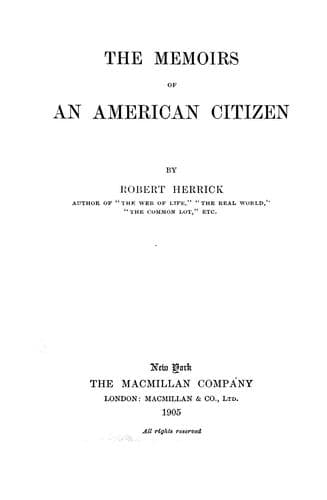
Capitalists and financiers -- Fiction; Chicago (Ill.) -- Fiction; Meat industry and trade -- Fiction; Political fiction
But the insiders in the city knew that something had been wrong, and, as
Slocum said, the scandal connected with quashing that injunction
followed us for many years. It was of less importance to me than to
Slocum; for the men with whom I dealt were used to stories like mine.
They believed what they had a mind to, and did business. But for Slocum
it was more serious.
The worst of it for me was at home. Sarah brooded over the newspaper
talk until she was morbid, refusing to go almost anywhere she would be
likely to meet people she knew. The Bible classes had been given up,
and, naturally enough, we never went back to Mr. Hardman's church, nor
returned to our old church. Sarah and I talked about it once or twice,
but we got nowhere.
"I should think you would care for the children!" she would cry,
persisting in considering me as a criminal.
"You'll see that it won't make the smallest difference to any one a year
hence, if you'll only hold up your head!"
"Well, I don't understand business, but May thinks it pretty bad, I
know, because she doesn't come to the house any more when you are at
home."
"She has no reason to act that way. And I don't mean to have you or May
or any other woman holding me up with your notions of what's right and
wrong, just because the newspapers make a lot of talk."
That ended the matter between us; but for a long time Sarah avoided our
old friends, and the house was unusually quiet.
What troubled me more than the racket in Chicago was the way that Dround
and Farson and a few other of our backers might take the story. The
Drounds were in Egypt, but they would hear the news quickly enough. Mr.
Dround was the president of our corporation, and the most influential
single stockholder. With his ideas, he might become a nuisance, or draw
out altogether, which would be awkward in the present condition of the
company.
As for Farson, I always counted a good deal on that crusty bit of rock,
and he had never failed me yet. One thing after another had come up in
the last four years, and he and his friends had backed me solidly. We
were pretty deep in other enterprises than this packing
business--railroads and land in that Southwest where I had set my eyes.
While the scandal was the worst we never heard a word from Farson, and I
was congratulating myself that he had overlooked the matter, when one
morning I received a despatch: "Meet me Union Station twelve to-morrow.
FARSON." That was all.
When he got out of the sleeper that noon I missed his usual warm smile.
He refused my invitation to lunch at the City Club, and led the way into
the fly-specked, smelly restaurant at the station. We ate our miserable
meal, and he said little while I talked to him about our affairs. It was
like talking to a blank wall: he listened but said nothing. After a
while he interrupted me in a kind of thin whisper, as if his mind had
been absent all the time:--
"What about this Judge Garretson? It isn't true?"
"You mean what the papers say?"
Public-domain text, read in full here on John Shaqi.
Reviews
Reviews
No reviews yet
Be the first to share your thoughts on this work.
Elsewhere in the archive
Join the Discussion
Join the discussion
Sign in to leave a comment or review.
Sign InorCreate an account