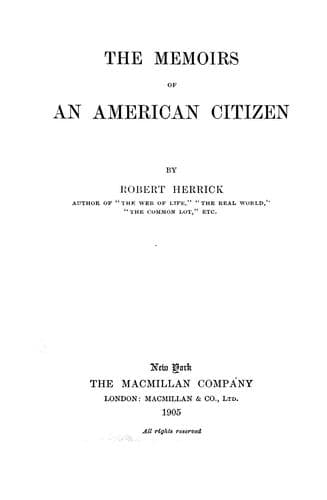
Capitalists and financiers -- Fiction; Chicago (Ill.) -- Fiction; Meat industry and trade -- Fiction; Political fiction
As the men raised their champagne glasses to drink to me, Slocum shook
me warmly by the hand, a smile broadening over his face. Although, as I
told them, it had never been my part to talk, I said a few words,
thanking them for their good-will, and promising them that I should do
my best to serve the interests of the country we all believed was the
greatest nation that had ever been. My old friend Orlando Bates, the
president of the Tenth National, replied to my talk, expressing the
confidence my associates had in me. In the course of his graceful speech
he said, "Mr. Harrington is so closely identified with the conservative
interests of the country that we can feel assured he will stand as a
bulwark against the populistic clamor so rife in the nation at the
present time." And young Harvey Sturm, also a bank president, who
followed him with a glowing speech, made flattering references to the
work I had done "in upbuilding our glorious commonwealth." After
deprecating the growth of socialistic sentiments and condemning the
unrestricted criticism of the press in regard to capital, he closed with
a special tribute: "Such men as Edward Harrington are the brains and the
will of the nation. On their strong shoulders rests the progress of
America. Were it not for their God-given energy, their will, their
genius for organization, our broad prairies, our great forests, our vast
mines, would cease to give forth their wealth!"
There was more of the same sort of talk before we broke up. Afterward,
as the theatres and the opera closed, men dropped in to hear the news,
and many of them came up to congratulate me. Among others old Dround
wandered into the club in the course of the evening, and, some one
having told him that I had been elected Senator, he came up to the
corner where I was standing with a group of men, and hovered around for
a time, trying to get a word with me. After a while I stepped out and
shook hands with him.
"I am very glad to hear this, Mr. Harrington," he said slowly, pressing
my hand in his trembling fist. "I have always believed that our best men
should take an interest in the government of their country."
His eyes had a wandering expression, as if he were trying in vain to
remember something out of the past, and he continued to deliver his
little speech, drawing me to one side out of hearing of the men who were
standing there. "I thought once to enter public life myself," he said,
"but heavy business responsibilities demanded all my attention. I
wonder," he lowered his voice confidentially, "if you will not find it
possible to further the claims of my old friend Paxton's son. He desires
to secure a diplomatic post. I have urged his merits on the President,
and secured assurance of his good-will; but nothing has yet been done. I
cannot understand it."
Eri Paxton was a dissipated, no-account sort of fellow, but I assured
Henry I. Dround that I would do my best for him. That was the least that
the past demanded of me!
Public-domain text, read in full here on John Shaqi.
Reviews
Reviews
No reviews yet
Be the first to share your thoughts on this work.
Elsewhere in the archive
Join the Discussion
Join the discussion
Sign in to leave a comment or review.
Sign InorCreate an account