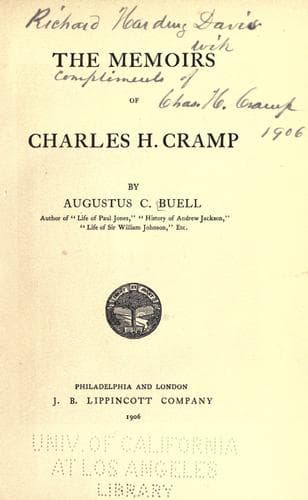
Cramp, Charles Henry, 1828-1913; Naval architects -- United States -- Biography
“Commodore Walker’s influence among Senators and Representatives in
Congress, built up during his first four years in the Bureau, was
superior to that of any other officer, and occasionally it proved
equal to that of a considerable majority of them combined. His
powers were uniformly exerted in behalf of the readiest and most
practical methods of increasing the navy in number, excellence, and
force of its ships and in organization and training of its
_personnel_. Against all efforts to perpetuate the obsolete,
cumbrous, and abnormal navy-yard system of construction he set his
face with all the strength and resolution he possessed. For detailed
discussion of the questions involved in this phase of the subject,
neither the limitations of space nor the patience of scientific
readers offer opportunity. Suffice it to say, that the antique,
red-tape-ridden and muddle-brained policy of trying to build new
ships of the modern type under military methods was in the main
abandoned.
“Commodore Walker also ably supported Mr. Whitney’s policy of
purchasing modern designs and plans of hulls and machinery abroad, a
policy which a large and influential group of naval officers
vehemently opposed. On the whole, it is not too much to say that, in
the all-round importance of his usefulness to the new navy,
Commodore Walker fairly divided honors with Mr. Whitney himself.
“That Walker’s all-round ability and energy were understood and
appreciated by others besides Secretary Whitney is abundantly
attested by the fact that upon his retirement in 1897, at the age of
sixty-two, he was appointed chairman or president of the Isthmian
Canal Commission, which he still holds at this writing (1903), in
his seventieth year. Taking his career altogether from graduation at
the Naval Academy in 1856; then through the Civil War, in which he
played a distinguished part; then for some time in the civic
pursuits already mentioned; then as Chief of Bureau and principal
adviser to the Secretary for eight years; then as Admiral in command
of the ‘White Squadron’; and, finally, as president of the Canal
Commission, it is safe to say that few officers in our navy have
done more important public service than John G. Walker.”
The most important matter adjusted in the conferences of Mr. Cramp with
Mr. Whitney was the arrangement of the form of contract so that it might
be, within a narrow margin, flexible or elastic. The operation of other
contracts had clearly shown the need of such modification, and a
solution was reached without difficulty, though not without much
deliberation.
Public-domain text, read in full here on John Shaqi.
Reviews
Reviews
No reviews yet
Be the first to share your thoughts on this work.
Elsewhere in the archive
Join the Discussion
Join the discussion
Sign in to leave a comment or review.
Sign InorCreate an account