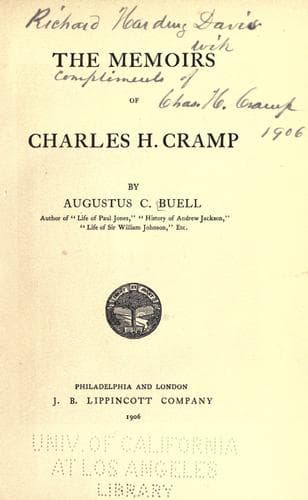
Cramp, Charles Henry, 1828-1913; Naval architects -- United States -- Biography
“The Secretary handed my details and allotment of weights to the
proper officer, and the Department proceeded to get up the plans and
specifications. Frequent interviews with the Secretary occurred as
the work progressed, and I felt sure that under Class II, permitting
alternative designs, the contract would be awarded. Before the time
for awarding the contract had arrived, I found that the plans were
being developed under the conditions that I had given the Secretary;
but when the plans were exhibited before bids were sent in, it
transpired that the boilers had been placed three abreast in the
government plans, bringing them within a few feet of the side of the
ship.
“I then designed a plan for arranging the six boilers in pairs,
making the coal-bunkers on the sides of the ship. This arrangement
of coal-bunkers facilitated the prompt coaling of the ship and the
handling of it. It also permitted a liberal amount of ‘coal
protection’ for the boilers and engines, which was considered of
important value at that time, and, what was of more weight than any
other consideration, the introduction of two longitudinal bulkheads
that extended the entire length of the engine and boiler spaces on
each side of the ship. With three boilers abreast, the ship was
liable to be sunk at any time by a collision with a coal-barge or
passing schooner; any penetration of the side abreast of boiler,
besides resulting in a speedy foundering, would certainly unship the
side boiler, adding thereby an explosion to the other damage.
“With the boilers in pairs, it would be necessary for a ramming
vessel to penetrate the side and two bulkheads and enter ten feet to
do any damage, so the chances of being destroyed by ramming would be
reduced to a minimum. I also lengthened the vessel over the
Department’s plan, but kept all the conditions of specifications
intact, except as to dimensions.
“After the bids were opened, it was found that ours was the lowest
in Class II, and lower than any other bid, taking the competition as
a whole. The Secretary then called a conference, at which all the
bidders and the Chief Constructor were present, and, after thorough
discussion of all the points involved, awarded the contract to the
Cramp Company under the bid in Class II on the modified plan I had
suggested and offered as to boiler arrangement and other details
conformable to it.
“The ship was named the ‘New York,’ and on trial trip she largely
exceeded her contract speed and requirements of coal endurance and
in all other respects; while the ‘Blake’ on trial was a failure; her
engines had to be practically rebuilt, and then did not come within
the scope of reasonable competition.
Public-domain text, read in full here on John Shaqi.
Reviews
Reviews
No reviews yet
Be the first to share your thoughts on this work.
Elsewhere in the archive
Join the Discussion
Join the discussion
Sign in to leave a comment or review.
Sign InorCreate an account