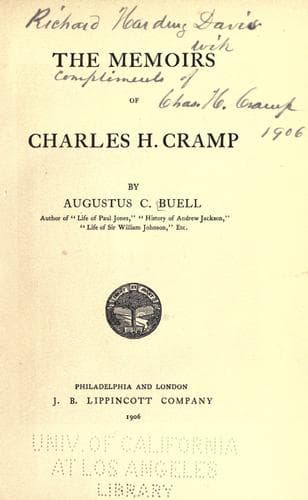
Cramp, Charles Henry, 1828-1913; Naval architects -- United States -- Biography
Among the most important services of Mr. Cramp to the new navy was his
instrumentality in bringing about the system of classifying bids. Prior
to 1885, whenever contract construction was to be done, the plans of the
Department, pure and simple, were the standard. If any bidder proposed
to deviate from them in any way,—no matter how palpable the
improvement,—his bid would be held irregular and thrown out. The issue
came on the machinery of the ships authorized by the Act of March 3,
1885. Of these four ships, the “Baltimore’s” plans had been purchased
abroad, hull and machinery, and were accepted practically without
change. But the Department’s design involved the then nearly, if not
quite, obsolete compound engine for the other three, “Newark,”
“Yorktown,” and “Petrel.” Mr. Cramp, desiring to bid on the “Newark” and
“Yorktown,” was doubtful whether he could develop the indicated
horse-power, which the form of contract required him to guarantee, with
the Department’s compound engines. He was, however, confident that he
could do it with triple-expansion engines of his own design.
To overcome the difficulty, he suggested to Secretary Whitney that, in
issuing the circular asking for proposals, a classification of bids be
provided for. This suggestion was at once adopted, and bids were
authorized to be offered in three classes: Class I, the Department’s
plans pure and simple; Class II, the Department’s plans modified by the
bidder as to hull or machinery or both; and Class III, the bidder’s
plans wholly. This arrangement broke up the embargo of the Bureaus, and
admitted the results of the study, experience, and skill of practical
ship-builders. Some of the Bureaus fought the plan with all their
energy, but the contest they made had no other result than to convince
them that Mr. Whitney was the _de facto_ as well as the _de jure_ head
of the Department,—a quite novel experience for them! Some time
afterward Classes II and III were merged, so that all departures from
the Department’s plans, whether modifications of them or complete
substitution of bidder’s plans for them, were grouped under Class II,
which has become the established practice in inviting proposals. Mr.
Cramp’s bids have usually been in Class II; involving in most cases more
or less extensive modifications of the Department’s plans, and in two
cases, the “Philadelphia” and the “Maine,” his own plans complete. The
value of this new departure lay in the fact that it gave the Navy
Department the benefit of all the progress of the country in the
ship-building art as actually practised by men who were building ships
for a living, and emancipated it from the dominion of the cloister. It
has become a part of the permanent policy of the government.
[Illustration: CRUISER VARIAG—RUSSIAN]
Public-domain text, read in full here on John Shaqi.
Reviews
Reviews
No reviews yet
Be the first to share your thoughts on this work.
Elsewhere in the archive
Join the Discussion
Join the discussion
Sign in to leave a comment or review.
Sign InorCreate an account