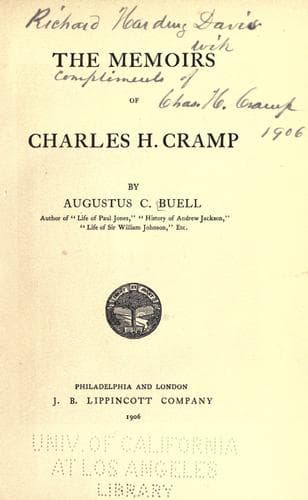
Cramp, Charles Henry, 1828-1913; Naval architects -- United States -- Biography
“Quite a number of the Popoff type of floating batteries were built,
and a dry-dock was constructed for their special accommodation when
repairs might be necessary. The ‘Livadia’ was the last production of
Admiral Popoff, who, as I have already remarked, designed her with
the assistance of Dr. Zimmerman, of Holland. She was not circular
like her predecessors, but was oval in shape, the transverse
diameter being almost but not quite equal to the conjugate, and she
was fitted with three screws entirely under the bottom. Captain
Semetschkin informed me that the Grand Duke was much impressed with
this new design, and that nothing could shake his belief in its
success. Being thus forewarned, I could avoid giving him an adverse
criticism in case he brought the subject up by simply exercising a
little diplomacy, as it was not my desire or intention to cross his
predilections in any way. When I called on the Grand Duke at the
Russian Legation, I found him reclining on a sofa, having severely
injured his leg in a fall. He arose as I entered and invited me to
take a seat in front of him. Being full of the subject, he
immediately asked me if I would visit Glasgow soon, and when I
stated that I intended to go there at an early date he gave me a
letter to Captain Goulaieff, Russian Naval Constructor, who he said
had charge of the construction of the new ‘Livadia,’ and that he had
had prepared a working model fifteen feet long with engines complete
as an experiment, and he wanted me to see it.
“I am sure he fully believed in the successful future of this type.
He stated that he was confident that it would revolutionize
merchant-ship as well as war-ship construction, and his enthusiasm
was unbounded in the contemplation of it.
“When he had exhausted the subject, which took some time, in elegant
English and with fascinating fluency of speech, he changed the
subject, and I was subjected to one of the most severe examinations
in naval construction, equipment, and technical practice that I ever
encountered. Of course, there was a change from my attitude of
listener to that of a sort of principal in the conversation that
followed.
“In referring in a complimentary way to the new fleet that we had
turned out,—the outcome of the ‘Cimbria’ expedition,—the Grand Duke
stated that one quality in them that impressed him more than any
other was the large coal carrying capabilities of the vessels, and
he asked me how I explained it. I stated that the models of the
ships were of the best American type with certain improvements of
our own.
“Expressing himself in a complimentary manner as to what we had done
and as to what I said, he then put the question to me with much
‘empressement’ and sympathetic interest of manner: ‘Mr. Cramp, from
what school of naval architecture did you graduate?’
Public-domain text, read in full here on John Shaqi.
Reviews
Reviews
No reviews yet
Be the first to share your thoughts on this work.
Elsewhere in the archive
Join the Discussion
Join the discussion
Sign in to leave a comment or review.
Sign InorCreate an account