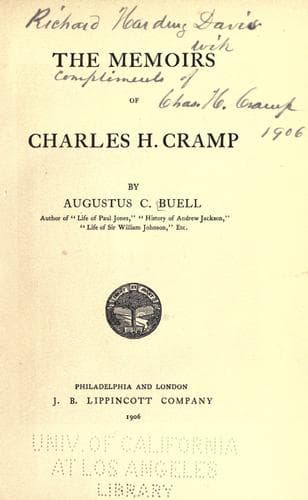
Cramp, Charles Henry, 1828-1913; Naval architects -- United States -- Biography
“As it was necessary to raise the turret in order to raise the deck,
and as we were compelled to haul the vessel out of the water, we
took the guns out of the turret and proceeded to remove it also.
Hoisting out the guns was an easy accomplishment, but the removal of
the turret was a difficult problem.
“At first sight, cutting out the rivets and bolts, taking apart and
rebuilding it, appeared the most feasible. This, however, was an
expensive transaction. After careful investigation, we concluded
that it could be hauled off the ship on to the dock on sliding-ways
if the work was done with the greatest rapidity with the best men at
it. The removal of guns and turret to the dock was successfully
accomplished.
“On account of the great cost due to occupying a dry-dock long
enough to make the change, it was determined to haul her out on
sliding-ways, reversing the process of launching, and that without
using a coffer-dam for laying the ground-ways.
“The vessel was hauled out by the use of six 12-inch falls, two of
which were attached to end of upper ways, two to a chain that passed
around the stem extending to amidships, the ends lashed to the ship
just above high-water mark, and the other two to holes in the bow
made for the purpose.
“When the six large ‘crabs’ were started with all of the men that
could be put on them, they never stopped until the vessel was
entirely out of the water, taking a day and a night for the
operation.
“This was by all odds the heaviest vessel ever hauled out on ways in
this country, and, in view of the simplicity of its preparations and
the limited cost, was one of the great achievements of the time
occupied by the Civil War. But little or no notice was taken of it
by the papers, as battles lost and won were the sensation of the
day.
“While the craze for constructing monitors had possession of the
country, the government built nothing else in the way of armored
vessels.
“Mr. Lenthall and Mr. Isherwood, who was on Mr. Lenthall’s staff at
that time, had no power to antagonize the monitor craze
successfully, and a large one of wood was ordered to be built in
each navy-yard, to be designed by the constructor of that particular
yard as far as the hulls were concerned. But little money of the
vast expenditures of the navy during the war was devoted to other
iron-clad constructions than that of the monitor class.
Public-domain text, read in full here on John Shaqi.
Reviews
Reviews
No reviews yet
Be the first to share your thoughts on this work.
Join the Discussion
Join the discussion
Sign in to leave a comment or review.
Sign InorCreate an account