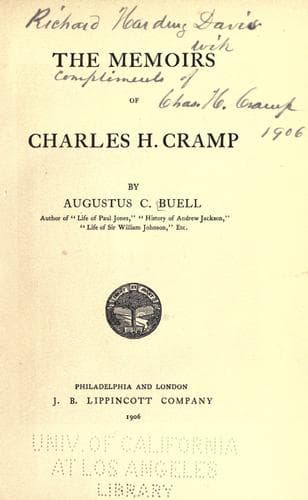
Cramp, Charles Henry, 1828-1913; Naval architects -- United States -- Biography
“The ‘Miantonomah,’ which was one of these vessels built in one of
the navy-yards and designed by the constructor at the navy-yard in
which she was built, was sent to Russia under command of Commodore
John Rodgers with Assistant Secretary Fox, as Special Envoy to
convey to the Emperor certain congratulations. The idea was that the
government of Russia would construct a number of large monitors. The
trip, so far as that was concerned, was a failure. Commodore
Rodgers, who went in command, was formerly in command of one of the
original monitors which had been engaged in the contests before
Charleston, and also in the Savannah sounds in the Civil War, and he
was one of the strongest of the captains in favor of that type. As a
rule, the captains and other officers were all adverse to them.
“While the Navy Department and Naval Committee of Congress were
favorable to the monitor type, Messrs. Lenthall and Isherwood were
against it; but they were very backward in doing or in recommending
anything else, and permitted themselves to be overlooked. In view of
this negligence on their part, it was argued that it was better to
try to do something, even if it turned out wrong, than to do nothing
at all.”
ORIGIN OF FAST CRUISERS.
“On account of the heavy loss of our ships captured by the
Confederate cruisers, and our failures to capture any of them with
the exception of the ‘Alabama,’ which was accidentally discovered
and destroyed by the ‘Kearsarge,’ our Navy Department conceived it
necessary to have constructed a number of very fast cruisers, faster
than any known afloat.
“The Department delegated Messrs. Stimers and Allen, when in the
height of their power in their ‘Sub-Department’ in New York, to
design and have them constructed.
“Not being naval architects, and not having any naval architect of
competent knowledge in connection with their ‘Sub-Department,’ but
having an exalted idea of their own abilities not only as naval
architects and engineers, and everything else in that direction,
they designed some ships of a peculiarly fantastic model, and
engines of equally fanciful character which they called, for short,
the ‘grasshopper engine.’
“Having the power to design these vessels and contract for them,
they invited me to inspect the plans and build two of them.
“On looking over these designs, I began to criticise them, and
recommended modifications.
“I was wound up suddenly by the observation that, as they intended
to give us two ships and give us what they considered a fair price
for them, we must build them exactly as they were designed.
Public-domain text, read in full here on John Shaqi.
Reviews
Reviews
No reviews yet
Be the first to share your thoughts on this work.
Join the Discussion
Join the discussion
Sign in to leave a comment or review.
Sign InorCreate an account