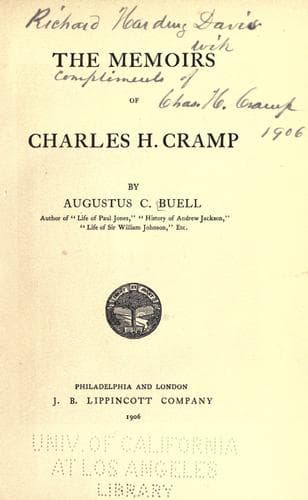
Cramp, Charles Henry, 1828-1913; Naval architects -- United States -- Biography
“As the price they offered was high, and feeling that we would
practically have our own way with them, provided we adhered to the
general type of design, and having no responsibility, we thought
that we had better take them and make a handsome sum out of them
than to stand out on trifles and fight for glory alone.
“I had commenced at the beginning of the war with criticising the
monitors, and our concern got nothing, and the grass might have been
growing in our yard if we adhered to that course. So the price was
fixed for these ships, and we were about going on, when the fatal
contretemps of the launching of the Boston light-draught monitor
occurred. The ‘fast cruiser’ contracts of Stimers and Allen were set
aside, and a large sum of money saved to the government. The ring
was broken. They who had had unlimited power heretofore suddenly
found themselves without the power to contract for a dingy.
“This was really a great disappointment to us and several other
contractors, because the price they fixed for the cruisers was
liberal, and, as they would not listen to suggestions, they were
naturally expected to take the responsibility.
“After the matter of the fast cruisers was taken out of the hands of
the ‘Sub-Department of the navy’ after the sinking of the Boston
monitor, the Navy Department ordered each of the four navy-yards to
design one on a scheme of general dimensions, and giving the engines
out by contract to the various engine-builders, the engines, with
two exceptions, being designed by Mr. Isherwood. The machinery for
the ‘Madawaska’ was designed by Ericsson!
“At the same time, to encourage private enterprise, one was given to
us, hull and machinery of our own design. We awarded the engines to
Merrick & Sons, who built them on their own designs. All of these
vessels were constructed of wood. Our ship was called the
‘Chattanooga,’ and that built at the Philadelphia Navy-Yard was
called the ‘Neshaminy.’
“The engines designed by Mr. Isherwood were geared, the propellers
making two and one-half revolutions to the engine’s one. When these
engines were designed, gearing was supposed to be an indispensable
necessity in screw-engine practice.
“The engines designed for the ‘Madawaska’ by Ericsson were of the
same design as that of the ‘Dictator,’ and would be considered of
fantastic character at the present time; that, however, might be
said of most marine engines of that period.
“Much was expected of the ‘Madawaska’s’ engines by Mr. Ericsson’s
friends, but after a trial of twenty minutes it was stopped, as the
crank-pin and main-bearing brasses ran out into the crank-pit before
they had attained their required performance.
Public-domain text, read in full here on John Shaqi.
Reviews
Reviews
No reviews yet
Be the first to share your thoughts on this work.
Join the Discussion
Join the discussion
Sign in to leave a comment or review.
Sign InorCreate an account