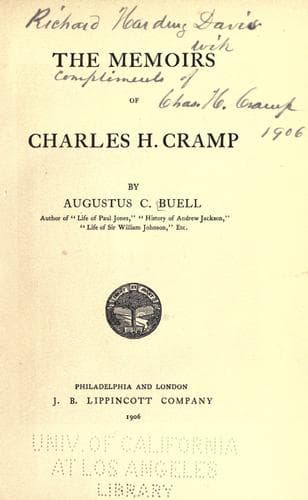
Cramp, Charles Henry, 1828-1913; Naval architects -- United States -- Biography
“The engines were subsequently taken out and compound engines of
poor design were put in by parties who had never built a compound
engine before. The performance of these engines was but little
better than that of the original.
“Having been eminently successful in the introduction of compound
engines in this country, by the construction of four compound
engines for the American Line and one set for the ‘George W. Clyde’
of our own design, we made application to the government to
substitute the design of compound engines in place of the first set
of ‘Madawaska,’ but our offer was not accepted, unfortunately for
the government.
“All of these vessels were of good model, and all built according to
the latest improvements of the great ship-builders and contractors,
and the devices in the way of rigging, spars, and other outfit,
besides the model and general arrangements were from the stand-point
and designs of the naval constructor and ship-builder at the yard
where they were built. No ships in modern times have been superior
to them in design, construction, and ship-building technique. The
engines, however, were not up to the standard, and, no matter what
else may be said of them, they were much too small.
“Some time after these vessels were laid up, an effort was made by
private parties in New York to utilize them in a trans-Atlantic line
to carry the mail, and a proposition was made to the government
covering certain conditions under which they could be operated. The
proposition meeting a favorable consideration, an exhaustive
examination of the engines was made by Mr. Norman Wheeler, of New
York. He found that the gearing of the driving-wheels and pinion had
been worn down five-eighths of an inch during their trials; the
project was abandoned, and the ships gradually disappeared.
“It has been stated that the ‘Wampanoag’ made her designed speed
from New York to Charleston in one trial.
“The British government was very much interested in this scheme of
building fast cruisers for our navy. Captain Bye-the-sea, who was
Naval Attaché of Great Britain, was ordered to investigate the
matter here. He decided to obtain the plans and drawings of the
‘Chattanooga,’ and applied to the Secretary of the Navy for his
approval. The Secretary sent a letter to us stating that, so far as
he was concerned, he had no objection. So we furnished Captain
Bye-the-sea with the drawings of the ‘Chattanooga’ in return for
some valuable information that he had, which we expected to utilize
in some construction of our Navy Department. We did not, however,
realize anything in that direction.
Public-domain text, read in full here on John Shaqi.
Reviews
Reviews
No reviews yet
Be the first to share your thoughts on this work.
Join the Discussion
Join the discussion
Sign in to leave a comment or review.
Sign InorCreate an account