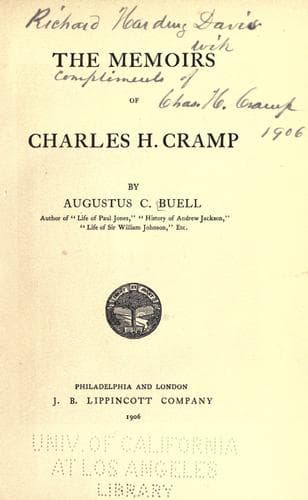
Cramp, Charles Henry, 1828-1913; Naval architects -- United States -- Biography
“The ‘Inconstant,’ built by the British government, was practically
the same model as that of the ‘Chattanooga,’ but with another deck
added to her, which gave her an entirely different appearance, and
which made her look a good deal heavier above the water than the
‘Chattanooga’ did, particularly as far as the stern was concerned.
“The ‘Wampanoag,’ one of the ships built at one of the navy-yards,
made what was designated as one quick trip from New York to
Charleston; but in doing so the teeth of the gearing were worn to
the extent of five-eighths of an inch, practically ruining her
usefulness for any future service. The vessel was laid up and never
sent to sea again.
“The ‘Chattanooga’ did not make a successful trial. The engines were
too small, and a long contest between the engine-builders and Mr.
Isherwood occurred over the construction of the machinery, ending in
the engine-builders making modifications, and the vessel was laid
up.
“As these ships were considered at that time too expensive to equip
for sea service in time of peace, they were laid up; being wooden
and very much neglected, they rotted at their wharves.
“The failure of these vessels to demonstrate the propriety of
building fast cruisers was due altogether to defective machinery and
to defective marine engineering as it generally existed at that date
in this country, and to the material of their construction being of
wood.”
EVOLUTION OF MODERN MARINE ENGINE.
“At that time a large majority of the marine engineers of the United
States were adherents of the paddle-wheel, walking-beam type of
engine, and nothing would do but that type of engine. That was
particularly the case in the city of New York.
“Philadelphia, at a very early period in the history of steam
propulsion, advocated the propeller engine, and as far as the
working of propeller engine was concerned, the degree of workmanship
and skill in its design attained there was never excelled in Europe
or America. These engines were generally small in power, and the
prejudices of the people were against them, particularly as all New
York ship-builders and marine engineers spoke of propeller engines
with the most profound contempt.
“Now and then some one in New York would build a propeller engine of
poor design which would prove disastrous, so in large enterprises
the walking-beam, side-wheel type of engine prevailed and was the
fashion.
“This was done to such a great extent that when the first line of
steamships was established between Philadelphia and Charleston,
side-wheel engines were put in them by parties who had a great deal
of interest with the management of the steamship company.
Public-domain text, read in full here on John Shaqi.
Reviews
Reviews
No reviews yet
Be the first to share your thoughts on this work.
Join the Discussion
Join the discussion
Sign in to leave a comment or review.
Sign InorCreate an account