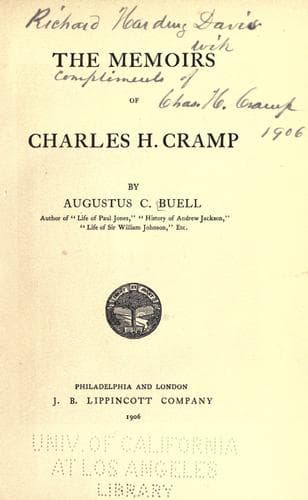
Cramp, Charles Henry, 1828-1913; Naval architects -- United States -- Biography
It was at this time that the Cramp Company considered it indispensable
to attach engine building to the construction of hulls, as no
satisfactory arrangement could be made to secure accurate performance
that involved two independent and diverse handicrafts in the
undertaking. They secured the services as engineer of Mr. J. Shields
Wilson, whose training in the I. P. Morris Company, and at Neafie &
Levy’s works had demonstrated his fitness for the post, and as to whose
methods they were familiar.
One of the first achievements of the new enterprise was the design and
construction of the compound engines for the “George W. Clyde,” finished
in the spring of 1872, the first present accepted type of compound
marine engines built in America. Immediately following them in 1873 and
1874 were the four ships for the American Line, the “Pennsylvania,”
“Ohio,” “Indiana,” and “Illinois.”
The “George W. Clyde” was built for Thomas Clyde, who was the first
ship-owner to introduce screw propulsion in ocean commerce in the United
States by building the twin-screw steamship, the “John S. McKim,” built
in 1844, which he used in the trade of the Gulf of Mexico and as a
transport when the war with Mexico occurred.
Having built the first screw steamship, the “John S. McKim,” and the
first steamship with compound engines, the “George W. Clyde,” Mr. Clyde
responded with alacrity to the recommendations of Mr. Cramp in favor of
the use of the triple-expansion engines by building the “Cherokee.”
The “Mascott” for Mr. Plant was built at the same time.
Mr. Clyde had formed the acquaintance of Mr. Ericsson soon after his
arrival in this country in 1839, just before the “John S. McKim” was
constructed, and became an early convert to his fascinations in
exploiting the superior merits of screw propulsions over every other.
The “John S. McKim” and engines were designed by Mr. Ericsson, and built
near Front and Brown Streets, Philadelphia.
Mr. Jacob Neafie, of Reaney, Neafie & Co., celebrated engine builders,
who began business soon after by constructing propeller engines, had
considerable practical experience in the construction of the “John S.
McKim’s” engines before Reaney, Neafie & Co. had started business.
Mr. Ericsson had early secured the friendship of Commodore Stockton, and
had a boat built for towing purposes by the celebrated ship-builders
Lairds, of Berkenhead, called the “R. F. Stockton.” Commodore Stockton
had been already biased in favor of screw propulsion on account of the
invention of the screw propeller as it practically exists to-day by John
Stevens in 1803. Mr. Stevens was the head and front of the organization
of the bay, river, and canal navigation between the two great cities of
New York and Philadelphia, of which Commodore Stockton was a member.
The successful introduction of screw propulsion in the United States was
certainly owing to the combined efforts of Stevens, Ericsson, and Clyde.
Public-domain text, read in full here on John Shaqi.
Reviews
Reviews
No reviews yet
Be the first to share your thoughts on this work.
Join the Discussion
Join the discussion
Sign in to leave a comment or review.
Sign InorCreate an account