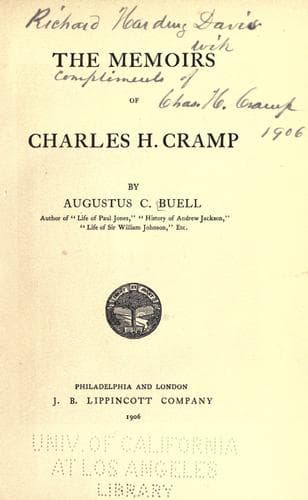
Cramp, Charles Henry, 1828-1913; Naval architects -- United States -- Biography
Foreign Commerce in 1865—The “Clyde” and “George W. Clyde,” and
Introduction of Compound Engines—Commerce of 1870—Merchant
Marine—Lynch Committee—Mr. Cramp and Committee—Lynch Bill—American
Steamship Company—Visit to British Shipyards—John Elder—British
Methods—Interchange of Methods—Merchant Marine continued—Dingley
Bill—Defects—Act of 1891, Providing Registry for Foreign Ships—“St.
Louis” and “St. Paul”—Extract from _Forum_—Remarks on
Article—Committee of Ship-builders and Owners—New Bill Introduced by
Frye and Dingley—North Atlantic Traffic Association—New
Ship-yards—Tactics of North Atlantic Traffic Association—Our
Navigation Laws, _North American Review_—Mr. Whitney—Unfriendly
Legislation—Mr. Whitney’s Letter—Effects of Letter—Mr. Cramp’s Letter
to Committee of Merchant Marine—International Mercantile Marine.
THE return of peace in 1865 found the country without sea-commerce
either coastwise or foreign. Such ships as had not been taken up by the
government had, with the exception of a few whaling-vessels in the
Pacific Ocean, been transferred to foreign flags to save them from the
ravages of Confederate pirates or cruisers which, to all intents and
purposes, so far as construction, armament, equipment, and crews were
concerned, were nothing but British privateers in disguise. In the mean
time England had taken every advantage of the situation, and by 1865 had
practically absorbed all the magnificent ocean-carrying trade which the
United States enjoyed prior to 1860. American ship-building was at a
stand-still. The government at once threw upon the market all the ships
which it had taken up for gun-boats, auxiliary cruisers, transports,
etc., during the war. They were sold for anything that they would bring,
and they were bought up as a speculation by new companies unfamiliar
with the shipping business, and as a consequence they all failed. The
ships were obsolete or worn out and soon passed out of existence.
Certain coastwise lines continued to do a small business, but little or
no attempt was made to restore our foreign trade; first, because none of
the vessels which the government threw on the market were in a condition
to undertake it; and, second, because, in consequence of the inflated
prices of everything, any attempt to compete either in seafaring labor
or material with England would have been absurd. Besides this, the whole
energy and capital of the country were immediately directed to an
extraordinary expansion of railway systems, so that the attention of the
people was entirely diverted from the sea and fixed upon the interior.
For the next five or six years little or no ship-building of any
description was done anywhere in the United States.
Public-domain text, read in full here on John Shaqi.
Reviews
Reviews
No reviews yet
Be the first to share your thoughts on this work.
Join the Discussion
Join the discussion
Sign in to leave a comment or review.
Sign InorCreate an account