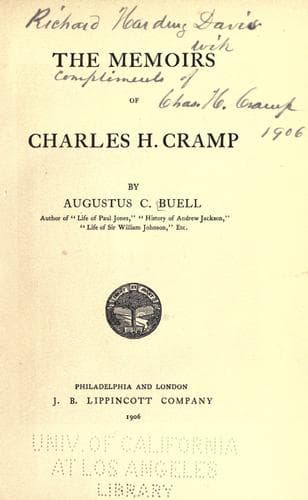
Cramp, Charles Henry, 1828-1913; Naval architects -- United States -- Biography
He reviewed briefly the struggle between the Cunard and Collins Lines
prior to 1858, and showed conclusively that the downfall of the American
Collins Line was due to the persistent and constantly increasing
subsidies lavished by the British government upon the Cunard Line, which
our government in 1858 met by withdrawing the Collins subsidy and giving
them instead the sea and inland postage on mail matter actually carried.
In this respect he said Congress indirectly came to the aid of the
Cunard Line and helped it to overthrow the Collins Line. He hoped that
the committee would give these particular facts their earnest attention.
He said that they did not require deep or intricate investigation,
because they were matters of common notoriety, known to everybody who
was at all conversant with the commercial history of the country.
The admission of material for building iron ships free of duty, he said,
would be an advantage, of course, and many believed that if our
ship-builders could be relieved from the tariff and get their material
free they could compete successfully with foreign builders; but the
difference in wages was too great to be entirely overcome by the mere
admission of materials duty free. As for materials, he would always
prefer American iron for the construction of ships to foreign iron,
provided it could be got at the same, or very nearly the same, price.
There were many inconveniences, he said, attendant upon sending abroad
for iron plates. He informed the committee that it was necessary to get
the form of every plate and have it sketched before it was ordered, and
if, after doing that, we must send abroad to have them made, very great
inconvenience and delay would result.
This statement of Mr. Cramp before the Lynch Committee, of which the
foregoing is only a synopsis, was really the key-note to all subsequent
argument in favor of government aid to American ship-building and
ship-owning. It presented the matter in a new light, or a light which
was new in 1870.
[Illustration: ARMORED CRUISER BROOKLYN]
It might be remarked here, in referring to his statement that “the form
of every plate must be sketched before it is ordered, etc.,” that Mr.
Cramp himself was the originator of that system in this country, a
system of ordering plates sheared to sizes at the mill. (See “American
Marine,” W. W. Bates.) Until he established this innovation, plates for
building iron vessels had been rolled as nearly as possible to the sizes
required and then sheared and trimmed at the shipyard. This itself was a
very remarkable and striking innovation, and was immediately taken up by
all iron ship-builders in the country, and is now the universal
practice.
The legislative result of the first effort of Congress to take
cognizance of the condition of the merchant marine was the bill
introduced by Mr. Lynch, February 17, 1870.
Public-domain text, read in full here on John Shaqi.
Reviews
Reviews
No reviews yet
Be the first to share your thoughts on this work.
Elsewhere in the archive
Join the Discussion
Join the discussion
Sign in to leave a comment or review.
Sign InorCreate an account