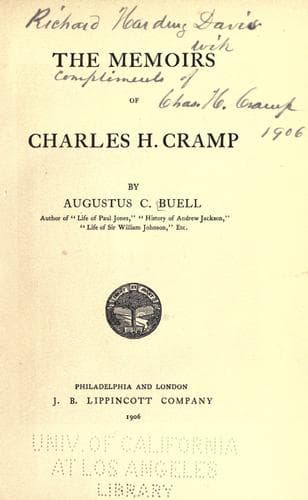
Cramp, Charles Henry, 1828-1913; Naval architects -- United States -- Biography
Mr. Lynch’s bill, although it may be described as the pioneer effort for
the resurrection of the American merchant marine, proposed in concise
form and plain, easily comprehensible terms, without any unnecessary
verbiage or circumlocution, as practical and as sensible a system of
subvention as has ever been put forward since. It was comprehensive in
its scope, universal in its application, and liberal in its provisions.
Later bills, more elaborately framed and more diffuse in their verbiage,
have hardly improved upon the simple matter of fact form in which Mr.
Lynch embodied his proposed policy.
This was the beginning of a Parliamentary war between American
ship-owners on the one hand and the influence of foreign steamship
companies on the other; a war which has at this writing lasted more than
thirty years.
One subsidy was granted by Congress at this early date, that of the
Pacific Mail Steamship Company; but hardly had that subsidy begun to
operate, when an exposure of certain methods by which it was procured
brought about a great public scandal, which for the time-being put a
peremptory end to the whole policy.
Whether the charge that the Pacific Mail subsidy was obtained by corrupt
methods was true or not, the means in obtaining it were no more corrupt
than those which have been employed by foreign steamship interests to
defeat legislation in Congress favorable to American shipping from time
to time ever since.
Notwithstanding these discouraging conditions, a group of Pennsylvania
capitalists formed “the American Steamship Company,” and decided in 1871
to try the experiment of an American Line to Liverpool. They contracted
with the Cramp firm for four first-class steamships, to be superior in
sea speed, comfort, and other desirable qualities to any foreign
steamship then in service. These four ships were designed by Mr. Cramp,
and built under his superintendence between 1871 and 1873 inclusive, and
were put in service under the names of the “Indiana,” “Illinois,”
“Pennsylvania,” and “Ohio,” now commonly known as the old American Line.
That these ships were designed with the highest degree of ability and
constructed with the utmost skill is sufficiently attested by the fact
that they are all in serviceable condition at this writing (1903), over
thirty years old. These ships broke the record in speed which was held
by the “City of Brussels,” and consumed less than half of the coal in
doing it.
As soon as the construction of these ships had been awarded to his
Company, Mr. Cramp determined to examine the conditions of marine-engine
development abroad, and with that object in view sailed immediately for
Europe. His narrative of the trip and its results are as follows:
VISIT TO BRITISH SHIPYARDS.
Public-domain text, read in full here on John Shaqi.
Reviews
Reviews
No reviews yet
Be the first to share your thoughts on this work.
Elsewhere in the archive
Join the Discussion
Join the discussion
Sign in to leave a comment or review.
Sign InorCreate an account