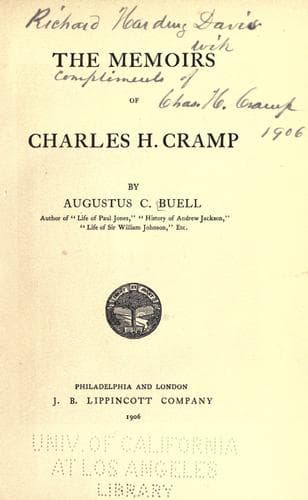
Cramp, Charles Henry, 1828-1913; Naval architects -- United States -- Biography
“To John Elder belongs the entire credit of introducing and
perfecting the compound engine, and there has been but little
improvement in his work up to this time. MacFarland Gray at that
time was a persistent advocate of this engine, and his work on
‘Engineering’ was of great value. He took especial pains to aid us
in our investigations.
“This trip was a most useful one besides the investigation of
compound engines; it gave us an opportunity of examining every
method pertaining to hull construction and equipment there, and to
discuss all of the problems and methods belonging to it.
“Two great changes in mechanical method and practice in certain
details of engine building took place in Great Britain as a result
of our visit, and the arrival of the ‘Pennsylvania,’ the first of
the American Line; although we took no active measures in that
direction.
“We found during this trip that the art of flanging boiler-plates in
Great Britain was entirely unknown, and that all British
boiler-heads were secured to the side plates and to the furnace ends
by means of angle bars in the corners, a crude and primitive method
of construction. It was impossible for us to understand this
backwardness or ignorance on the part of the British, as the
flanging of boiler-heads had always prevailed here.
“We called the attention of the British builders generally to this
superiority in boiler construction, but little or no attention was
paid to what we said at that time; but when the four ships of the
new line arrived in Liverpool, draughtsmen from all quarters were
sent to make sketches of the boiler work, and of many other devices
new to them, besides the boiler construction, one of which was the
use of white metal in bearings and journals. This feature in the
engine construction the British had not taken up when we visited
their works.
“We can claim to have introduced boiler flanging and the use of
white metal in British ship construction on account of our
recommendations, and the practical illustration of their utility on
the arrival of the ships of the American Line.
“The builders there, however, were very slow in the general adoption
of these methods. At first boiler-heads were delivered at
engine-works flanged by the mills that made the plates, and Sampson
Fox added boiler flanging to his business of making corrugated
furnaces. Having seen a boiler furnished with corrugated furnaces by
Sampson Fox in England, I introduced them in two yachts built for
George Osgood and Charles Osbourne, the first furnaces of the kind
in America. These yachts were known as the ‘Corsair’ and the
‘Stranger.’”
Public-domain text, read in full here on John Shaqi.
Reviews
Reviews
No reviews yet
Be the first to share your thoughts on this work.
Elsewhere in the archive
Join the Discussion
Join the discussion
Sign in to leave a comment or review.
Sign InorCreate an account