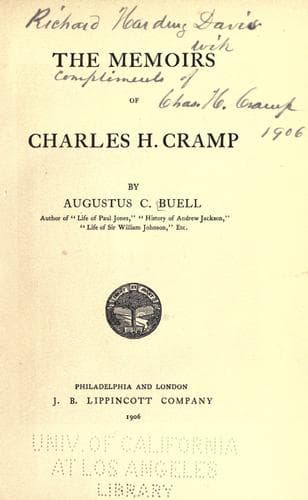
Cramp, Charles Henry, 1828-1913; Naval architects -- United States -- Biography
“It was due to this act of kindness on his part that our visits
afterward were so successful in the acquisition of valuable
information, and as to the generous hospitalities that we received.
We visited first the Thames Iron Works, John Penn & Sons, Mandsleys,
and others. From the Thames we went direct to the Clyde, where we
visited the Thompsons, the Lairds, Tod and McGregor, John Inglis,
Elders, and some others.
“The consensus of opinion of the different shipyards on the subject
of compound engines was, as a rule, unfavorable. We found that the
opposition was principally due to the fact that the change from the
old type to the new involved important and radical modifications in
the constructions of boilers and of engines, so they hesitated to
discard their old plans, patterns, and methods, the value of which
they were sure of, and to grope into an unknown field of augmented
costliness.
“Of course, these arguments to us were not convincing, and as we
advanced to the north we found ourselves quite biassed in favor of
the new type. Whatever doubts we may have had up to the time of our
arrival at the Fairfield Works, they were forever removed when we
visited their magnificent erecting shop. We saw there _thirteen
compound engines_ in various states of completion, with their
various parts ready for assembling, some about ready for
installation in the ship, the whole exhibiting everything in the way
of finish and arrangement both in their various parts and in the
whole erection. Up to this time we had encountered engines of the
oscillating type, the trunk, the plain vertical, and horizontal in
every varying form and construction. It was the same old story,—an
old one before we left home; and now, without any preparation
whatever for it, this vision of thirteen actualities of the new
departure burst upon our view. We spent the entire day there, the
Superintendent affording us every opportunity to examine the parts
and discuss the subject. We found as much novelty in the boiler
construction as in the engine.
“An old Philadelphia boiler had made its appearance here as ‘the
Scotch Boiler’; this differed from the old one only in the thickness
of the plates, due to the necessities of the use of higher steam.
“After this there was nothing to be seen, and we hastened home, and
in a very short time the Elder type of compound engines was under
construction for our new ships practically before any of the various
shipyards in Great Britain other than John Elders’ took hold of
them.
Public-domain text, read in full here on John Shaqi.
Reviews
Reviews
No reviews yet
Be the first to share your thoughts on this work.
Elsewhere in the archive
Join the Discussion
Join the discussion
Sign in to leave a comment or review.
Sign InorCreate an account