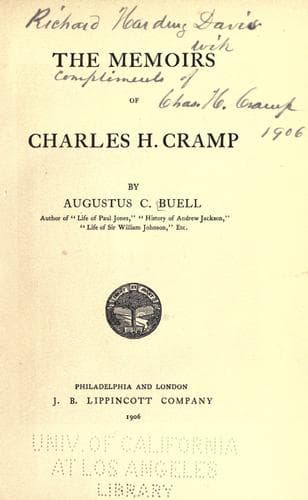
Cramp, Charles Henry, 1828-1913; Naval architects -- United States -- Biography
The investigation of the Dingley Committee led to the formulation of a
comprehensive measure known as the “Dingley Shipping Bill.” It was
thoroughly and exhaustively discussed through three Congresses, until
finally, in the last hours of the short session of the Congress ending
March 4, 1891, a bill was passed providing for a meagre and wholly
insufficient subsidy in the shape of special pay for carrying the ocean
mails of the United States. This bill was not only meagre in its
provisions, but it was not comprehensive in its application. It did not
result in any immediate increase of foreign tonnage. The following year,
however, Mr. Cramp, in a spirit of meeting the free-ship people
half-way, agreed to a compromise which provided that certain ships of
foreign (British) registry might be admitted to American registry,
provided their owners would contract to build two ships of equal class
and tonnage in the United States. This was the act by virtue of which
the English steamships “New York” and “Paris,” belonging to the
International Navigation Company, an American corporation and owned by
American capital, were brought under the American flag, and the “St.
Louis” and “St. Paul” were contracted for and built to meet the
condition imposed by this law.
The principal dimensions and qualities of these ships are as follows:
Length between perpendiculars, 535 feet 8 inches.
Length over all, 554 feet 2 inches.
Extreme beam, 62 feet 9 inches.
Depth from first deck to flat keel, 42 feet 4 inches.
Depth of hold for tonnage amidships, 23 feet 2 inches.
Height of bow above water-line at load draught, 39 feet.
Number of decks, 5.
Number of water-tight compartments exclusive of ballast tanks, 12.
Gross register, 10,700 tons.
Load displacement (about), 15,600 tons.
Dimensions of main dining-saloon, 109 feet 4 inches by 46 feet.
Dimensions of second cabin, 39 feet 6 inches by 56 feet.
Seating capacity of main saloon, 322.
Seating capacity of second cabin, 208.
Berthing capacity of steerage (about), 900.
[Illustration: ARMORED CRUISER NEW YORK]
The propelling machinery is a pair of vertical inverted
quadruple-expansion engines, to carry a working steam-pressure of two
hundred pounds and develop from 18,000 to 20,000 collective indicated
horse-power. These are the largest and most powerful marine engines ever
built in America, and, as the principle of quadruple expansion has never
before been applied on so large a scale, its results in this case have
been watched with interest by the entire profession of marine
engineering.
Structurally, the art of naval architecture has been exhausted in their
design, and the skill of the best mechanics in the world was tried to
the utmost in their construction. Whatever may have been their
performance as to speed and time of passage, nothing is hazarded in
saying that in safety, seaworthiness, and comfort they are not surpassed
by anything afloat.
Public-domain text, read in full here on John Shaqi.
Reviews
Reviews
No reviews yet
Be the first to share your thoughts on this work.
Elsewhere in the archive
Join the Discussion
Join the discussion
Sign in to leave a comment or review.
Sign InorCreate an account