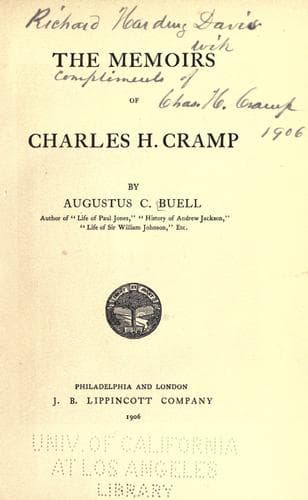
Cramp, Charles Henry, 1828-1913; Naval architects -- United States -- Biography
In the general public or patriotic sense the chief element of interest
in these ships is the fact that they represent the inception of an
effort to restore the prestige of the United States as a maritime
commercial power. The condition of affairs existing at the time the new
American Liners were projected was the culminating point of our
feebleness on the ocean.
The Act of 1891 was framed to expire by its own limitation in ten years
from its date. Taken in connection with the Act of 1892, already
referred to, it brought about the construction of two first-class
American trans-Atlantic greyhounds (the “St. Louis” and “St. Paul”).
Other companies or lines running to the West Indies, Mexico, and South
America were also stimulated to build a few new ships, but, generally
speaking, the effect of both these acts was limited, and produced no
serious impression for the better on the American merchant marine in
general.
This fact became evident very soon after these acts went into effect,
and it became clear that a broader and more comprehensive policy must be
adopted in the same direction if any great or lasting improvement of the
condition of our merchant marine was to be expected.
This led to the framing of a new act, thoroughly comprehensive in its
scope and universal in its application, on lines similar to those of the
Dingley Bill of 1882, but broader.
Prior to 1891, Mr. Cramp had confined the statements, deductions, and
arguments based upon his experience and observation wholly to hearings
before committees of Congress, with now and then a newspaper interview,
which in the nature of things must be transitory and soon forgotten. But
in the fall of 1891 he determined to place his knowledge before the
public in a more permanent form. This he began with a paper in the
_Forum_ for November of that year. The limits of this Memoir do not
admit of the reproduction of this paper in its entirety. It filled
sixteen pages of the _Forum_. The summary of the conclusion, however,
may be reproduced. After an exhaustive analysis of the existing
conditions and their causes, together with a survey of the probable
effects of the act approved the previous March (March 3, 1891), Mr.
Cramp summed up as follows:
Public-domain text, read in full here on John Shaqi.
Reviews
Reviews
No reviews yet
Be the first to share your thoughts on this work.
Elsewhere in the archive
Join the Discussion
Join the discussion
Sign in to leave a comment or review.
Sign InorCreate an account