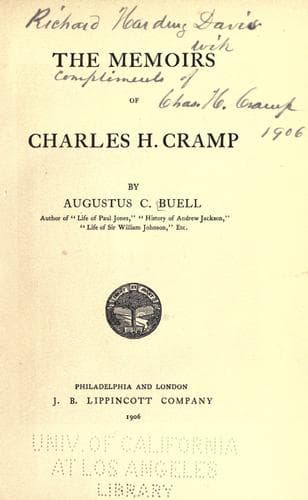
Cramp, Charles Henry, 1828-1913; Naval architects -- United States -- Biography
“Thus far I have dealt with facts only; and I have been careful to
avoid any matter susceptible of controversy. In conclusion, I will
venture a few deductions of my own, based upon the foregoing
statements of simple facts. I will assume at the start that our
internal development of farms, workshops, mines, railways,
coastwise, lake, and river commerce, etc., has reached a point at
which capital has reached its zenith of profitable investment in
them, and must look for some new field, not only for further
original investment, but also for the protection or betterment of
investments already made. In my judgment, our energy and enterprise
during the last twenty-five years have exhausted all the large
chances of fortune within the boundaries of the United States. Our
existing industries of every description represent an enormous
volume of local ‘plant’ and productive organizations quite up to our
local requirements for some time; hence it is necessary to seek
outlets for an inevitable surplus of product, and, in default of
such outlet, there must be a plethora of production which is bound
to result in stagnation, or, in other words, national apoplexy. For
this there can be but one preventive, ‘an ounce’ of which is said on
traditional authority to be ‘worth a pound of cure,’ and that is in
the development and retention of external market outlets. It is my
opinion that we can never secure these until we can ourselves
command the avenues to them. Commerce has its ‘strategy’ no less
than war. In war, strategy depends on lines of operation and
communication. At this time we possess neither for either commerce
or war. Our great rival controls both in every sense of the word.
To-day we could not even defend our own coasts against her obsolete
iron-clads in war, and we cannot control our own foreign commerce as
against the poorest and least seaworthy of her myriad of ‘ocean
tramps.’ If, for any reason, she were to withdraw from our trade the
vessels which, by virtue of our acquiescence, do all our
trans-Atlantic fetching and carrying for us, our peerless nation
would be laid helpless under an embargo compared to which that of
Jefferson’s administration would be but a mere trifle of annoyance.
It has seemed strange to me that so little attention is paid to this
fact. What would our political independence be worth, if
circumstances, likely to occur at any moment, should visit upon us
the consequences of our commercial servitude to England? and in a
less, though still important, degree to Germany?
Public-domain text, read in full here on John Shaqi.
Reviews
Reviews
No reviews yet
Be the first to share your thoughts on this work.
Elsewhere in the archive
Join the Discussion
Join the discussion
Sign in to leave a comment or review.
Sign InorCreate an account