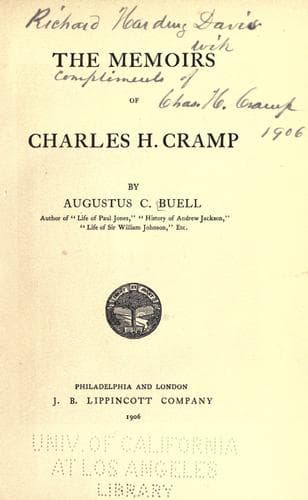
Cramp, Charles Henry, 1828-1913; Naval architects -- United States -- Biography
In 1897, Mr. Cramp, being prevented by other business from attending a
hearing before the Committee on the Merchant Marine on the day set for
his appearance, addressed to it a letter, in which, after briefly
reviewing the conditions and causes already set forth, he said:
“The interests of ship-owning and ship-building are identical,
because no nation can successfully own ships that cannot
successfully build them.
“No nation can either own or build ships when, unprotected and
unencouraged, if it is brought in competition with other nations
that are protected and encouraged.
“This is the existing condition of the ship-owning and ship-building
interests of the United States.
“The resulting fact is that the enormous revenue represented by the
freight and passenger tolls on our commerce and travel is constantly
drained out of this country into British, German, and French
pockets, in the order named, but mainly British; while the vast
industrial increment represented by the necessary ship-building
inures almost wholly to Great Britain.
“For this drain there is no recompense. It is sheer loss. It is the
principal cause of our existing financial condition.
“So long as this drain continues, no tariff and no monetary policy
can restore the national prosperity.
“Until we make some provision to keep at home some part at least of
the three hundred and odd millions annually sucked out of this
country by foreign ship-owners and ship-builders, no other
legislation can bring good times back again.
“It is a constant stream of gold always flowing out.
“The foreign ship-owner who carries our over-sea commerce makes us
pay the freight both ways.
“For our exports we get the foreign market price less the freight.
“For our imports we pay the foreign market price plus the freight.
“No fine-spun theory of any cloistered or collegiate doctrinaire can
wipe out these facts.
“The fact that so long as the freight is paid to a foreign
ship-owner, so long will it be a foreign profit on a foreign
product, is fundamental and unanswerable.
“The English steamship is a foreign product, and its earnings, which
we pay, are a foreign profit.
“No sane man will argue that a foreign profit on a foreign product
can be of domestic benefit.
“Add to this the fact, equally important, that the carrier of
commerce controls its exchanges, and the condition of commercial,
financial, and industrial subjugation is complete. Such is our
condition to-day.
“Great Britain has many outlying colonies and dependencies.
“The greatest two are India and the United States.
“She holds India by force of arms, whereby her control of that
country costs her something. She has to pay something for her
financial and commercial drainage of India.
Public-domain text, read in full here on John Shaqi.
Reviews
Reviews
No reviews yet
Be the first to share your thoughts on this work.
Elsewhere in the archive
Join the Discussion
Join the discussion
Sign in to leave a comment or review.
Sign InorCreate an account