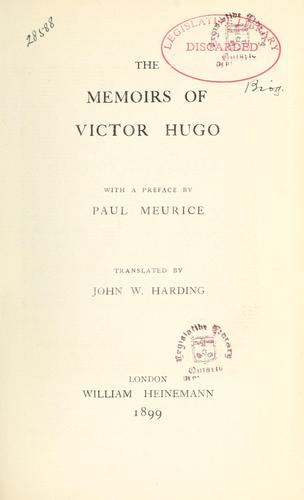
Authors, French -- 19th century -- Biography; Autobiographies; Hugo, Victor, 1802-1885
I was frightened at everything there, even at the servant who opened the
door. Well, I entered. Mme. de Chateaubriand was in the salon leading
to her husband’s study. It was a summer morning. There was a ray of
sunshine on the floor, and what dazzled and astonished me much more than
the ray of sunshine was a smile on Mme. de Chateaubriand’s face. “Is
that you, Monsieur Victor Hugo?” she said. I thought I was in the midst
of a dream of the _Arabian Nights_. Mme. de Chateaubriand smiling! Mme.
de Chateaubriand knowing my name, addressing me by name! It was the
first time that she had deigned to notice my existence. I bowed so low
that my head nearly touched the floor. She went on: “I am delighted
to see you.” I could not believe my ears. “I was expecting you,” she
continued. “It is a long time since you called.” I thought then that
there certainly must be something the matter either with her or myself.
However, she pointed to a rather large object of some kind on a little
table, and added: “I reserved this for you. I felt sure you would like
to have it. You know what it is?” It was a pile of packets of chocolate
made by some religious institution. She had taken the stuff under her
protection and the proceeds of its sale were to be devoted to charitable
works. I took it and paid for it. At that time I had to live for fifteen
months on 800 francs. The Catholic chocolate and Mme. de Chateaubriand’s
smile cost me 15 francs; that is to say, a fortnight’s board. Fifteen
francs meant as much to me then as 1,500 francs does now.
It was the most costly smile of a woman that ever was sold to me.
M. de Chateaubriand, at the beginning of 1847, was a paralytic; Mme.
Récamier was blind. Every day at 3 o’clock M. de Chateaubriand was
carried to Mme. Recamier’s bedside. It was touching and sad. The woman
who could no longer see stretched forth her hands gropingly towards the
man who could no longer feel; their hands met. God be praised! Life was
dying, but love still lived.
VII. DEBATES IN THE NATIONAL ASSEMBLY ON THE DAYS OF JUNE.
SESSION OF NOVEMBER 25, 1848.
What had to be determined before the Assembly and the country was upon
whom devolved the heavy responsibility for the painful days of June. The
Executive Committee was then in power; ought it not to have foreseen and
provided against the insurrection? General Cavaignac, Minister of
War, and, moreover, invested with dictatorial powers by the National
Assembly, had alone issued orders.
Had he issued them in time? Could he not have crushed the riot at the
outset instead of permitting it to gain strength, spread and develop
into an insurrection? And, finally, had not the repression which
followed victory been unnecessarily bloody, if not inhuman?
As the time for rendering an account approached Cavaignac became
thoughtful and his ill-humour was manifest even in the Chamber.
Public-domain text, read in full here on John Shaqi.
Reviews
Reviews
No reviews yet
Be the first to share your thoughts on this work.
Elsewhere in the archive
Join the Discussion
Join the discussion
Sign in to leave a comment or review.
Sign InorCreate an account